


It’s a fear you’ve probably had while working on your project: You spend a year on your board game. You’ve figured out how to find and hire an artist for your board game, you’ve playtested the mechanics to perfection, you’re done creating renders for your board game, you’ve finally settled on the name. You launch on Kickstarter, it starts doing great… and then someone you’ve never even met copies the whole concept and sells it for half the price.
If you didn’t protect your game before you launched, there usually isn’t much you can do about that.
There are many things that factor into how much it costs to publish a board game. One of the most expensive mistakes we see creators make has nothing to do with game design or ad strategy. It’s going public with an idea before locking down the legal side: the trademark, the copyright, the contracts. By the time it becomes a problem, it’s already expensive to fix.
To break this down properly, we brought in Zach Strebeck, a California-based board game and video game lawyer who’s worked with tabletop companies like Stonemaier Games, Restoration Games, and Dux Somnium.
To help future board game creators go into the process armed with understanding of the field, he covered the four types of intellectual property, which ones actually matter for a board game, and a pre-launch checklist you can run before you hit publish.
One important disclaimer up front: this isn’t legal advice. Treat it as a starting point, and talk to someone like Zach about your specific situation.
If you want it straight from Zach, you can watch the full video breakdown here:
Key Takeaways
- Trademark is the highest-leverage IP protection for most board game creators. File an “intent to use” application before you launch to lock in your priority date.
- Copyright is cheap ($65 to file) and fast, and it’s what lets you actually sue for infringement in US federal court, so it’s worth doing even if patents and trade secrets aren’t relevant to you.
- Patents rarely make sense for board games. They’re expensive, slow, and most game mechanics aren’t novel enough to qualify anyway.
- Run a trademark clearance search on 3 to 5 candidate names before you commit to one, since conflicts show up more often than most creators expect.
- Get signed, rights-assigning agreements with every artist, designer, and contractor before their work goes into your campaign.
Why IP Matters More Than You’d Think
Zach puts it plainly:
“Your intellectual property is your most valuable piece of property in your company as far as I’m concerned, especially for game companies and any kind of new media or new kind of product.”
You’ve got product inventory on the shelf, but the IP behind that inventory is what actually carries the value.
Crowdfunding makes your product public, which is the whole point of a campaign. It also puts your work in front of people looking for things to copy, and in front of others who might infringe on it without meaning to.
Two scenarios come up often. Your campaign starts gaining traction and someone decides to knock it off. Or a competitor is already using a name that’s the same as or similar to yours, and without a registered trademark or at least a filed application, you have limited ways to stop them. That’s especially true before you’ve sold any product, given how trademark rights work.
The fix is cheap ahead of time. The problem gets much more expensive after the fact.
The Four Types Of Intellectual Property
There are four categories, and only some of them tend to matter for board games.
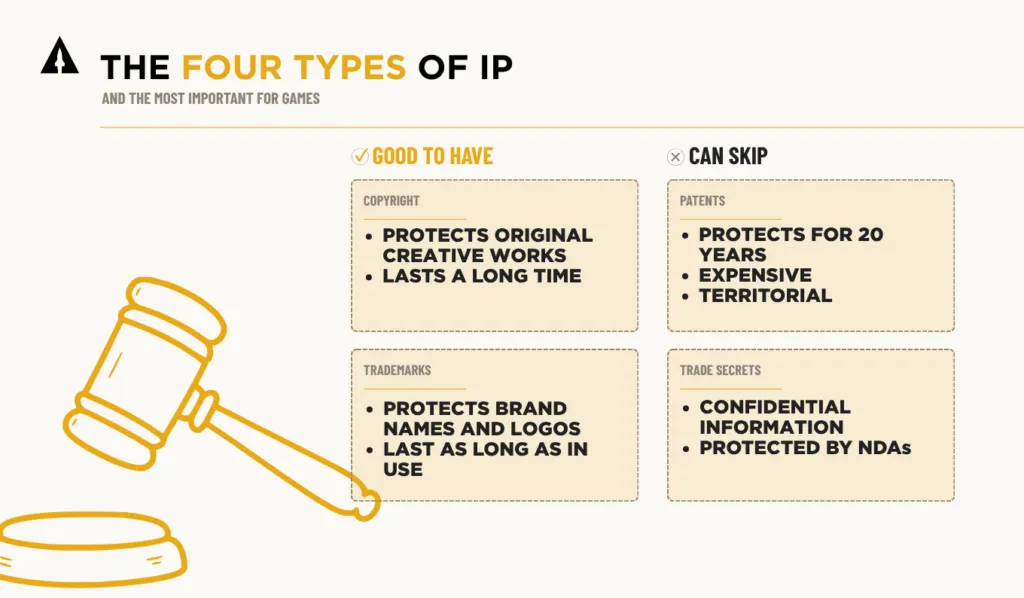
Patents protect a useful invention for 20 years, but they’re expensive and territorial. A US patent doesn’t help outside the US. Most game companies skip this one.
Copyright protects original creative works: art, rulebook text, music, sound design, photography. It lasts a long time (70 years after the author’s life, or for corporate-owned works, 95 years from publication or 120 from creation, whichever ends first) and costs very little to register.
Trademarks protect your brand names and logos. They last as long as you’re using them in commerce and keeping up with maintenance fees.
Trade secrets are valuable information you keep confidential rather than register, the way Coca-Cola keeps its formula. There’s no registration process. You protect these with NDAs and security measures instead. Most creators won’t need to think much about this category.
Understanding Patents
Patents split into two types. Utility patents protect how an invention functions. Design patents protect the ornamental appearance of a product, which matters in cases where trademark and copyright don’t reach far enough to cover the look and feel of what you’ve made.
Getting a patent is genuinely hard. You have to prove your invention is novel, non-obvious to someone else working in your field, functional, and falls into a patentable category like a machine or a composition of matter. You also have to disclose exactly how it works, in full. That’s part of why they’re expensive.
A typical utility patent costs $10,000 or more, and the timeline to get one is around three years, if granted at all.
There’s also a one-year clock. Once you publicly disclose an invention, you have one year to file or you risk losing your rights to it, and disclosure includes sharing it with any third party outside an NDA.
For most board game and tabletop creators, a patent isn’t worth pursuing. As Zach explains:
“It’s just sort of a something that it’s the artwork or it’s the trademark, the branding, that’s really going to be the thing that is valuable here and not the underlying invention itself.”
Most game mechanics are variations on existing ideas rather than new inventions in the patent sense. Add in the short shelf life of most games, typically a few years, and the math rarely favors filing. If you genuinely have a novel mechanism, or the product is central to your business and you’re courting investors, a consultation with a patent attorney before you disclose anything publicly is worth the conversation.
Trademarks: The One That Matters Most
For most crowdfunding creators, trademark is the highest-leverage piece of this whole conversation. Trademarks protect your brand names, logos, taglines, and distinctive design elements: the things that tell a customer which company a product is coming from.
In the US, you build trademark rights by using the mark in commerce. Outside the US, most countries use a first-to-file system, so whoever files the application first typically wins the rights, regardless of who used the name first.
Not all trademarks carry the same strength. The strongest are arbitrary marks (a common word applied to an unrelated product, like Apple for computers) or fanciful marks (a completely made-up word, like Xerox). One step down are suggestive marks, which take a small mental leap to connect the name to the product. At the bottom are descriptive or generic marks, names that just describe the product or a feature of it. These are the hardest to protect, and unfortunately the most common ones creators bring to their lawyers.
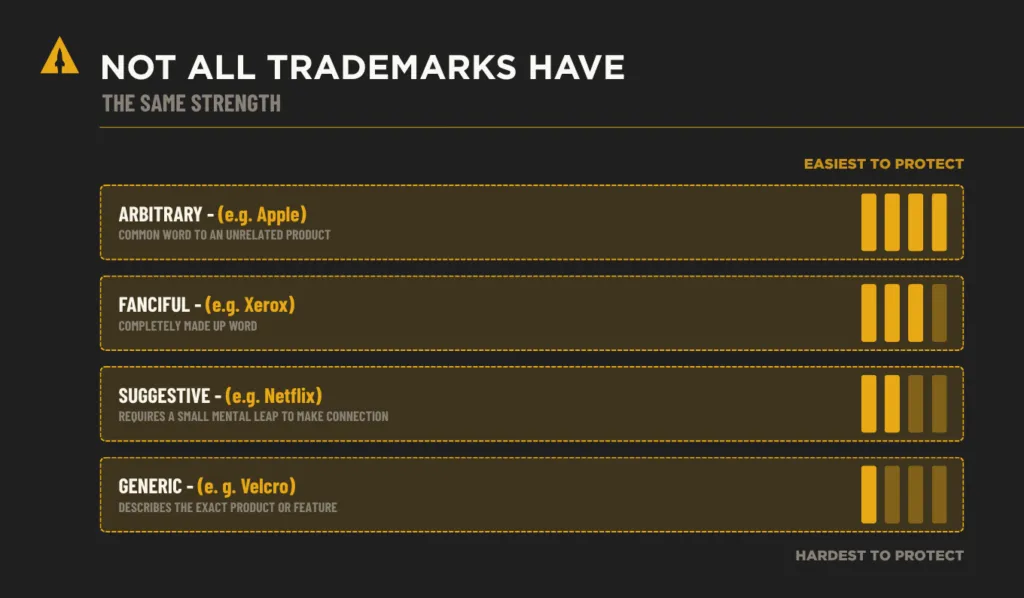
When you’re naming your product, this matters early. A name that just describes what the thing is might feel intuitive, but it’s also the hardest to defend, since no one gets to pull ordinary descriptive words out of the language for themselves.
Before you commit to a name, run a clearance search. Start with three to five candidate names, since trademark searches turn up conflicts more often than most creators expect. A thorough search covers the USPTO database, general web search, and product-specific platforms (for games, think Board Game Geek and relevant storefronts), because unregistered use can still carry rights that outrank yours.
Filing early matters because there’s usually a long gap between finalizing your name and actually shipping product. During that gap, someone else could start using the same name and gain priority over you. Filing an “intent to use” application locks in your priority date even before the product ships.
A filed trademark also opens up Amazon Brand Registry, business accounts on some social platforms, access to federal courts, and the ability to register with Customs and Border Protection to help flag counterfeit imports.
One caveat on timing: in the US, you generally have around three and a half years after filing to show actual use in commerce before the application lapses. If you won’t be selling within that window, it’s worth discussing timing with an attorney rather than filing too early.
Copyright Is Cheap, Fast & Worth It
Copyright protects your original creative work: art, rulebook copy, music, photography, software, video. It does not protect ideas, game mechanics or rules themselves, common genre tropes, purely functional designs, or general factual information. Names, logos, and slogans fall under trademark, not copyright.
You technically hold copyright the moment you create something, no registration required. So what does registering actually get you? Leverage. Without registration, you can’t sue for infringement in US federal court, which makes a cease-and-desist letter far less threatening.
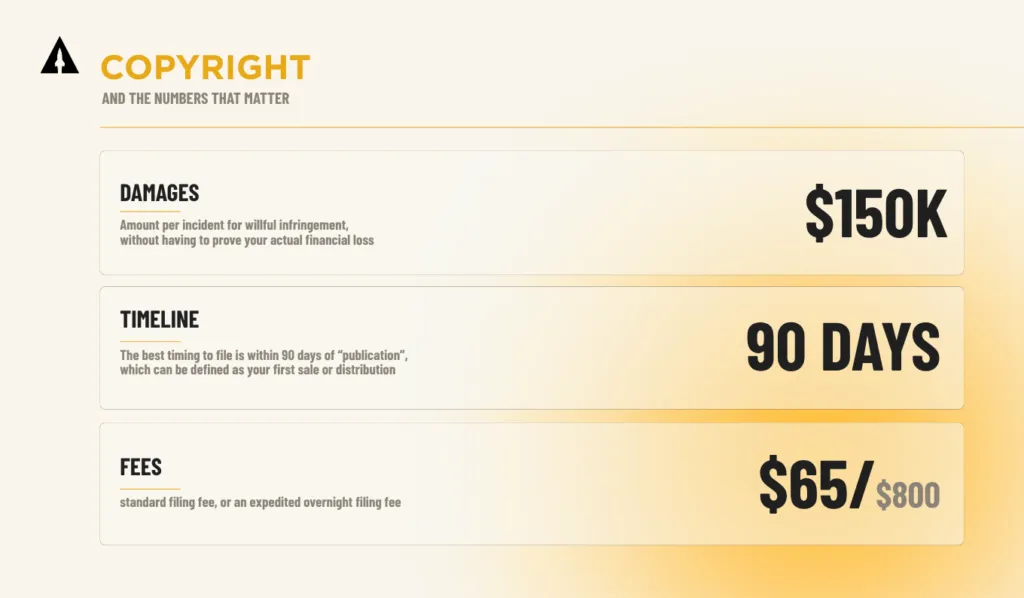
Registration also gives you access to statutory damages, up to $150,000 per work infringed for willful infringement, without having to prove your actual financial loss, which can otherwise be difficult to quantify.
To get the strongest protection, register within 90 days of “publication.” That word has a specific legal meaning here. Posting screenshots on social media doesn’t count. Actually selling or distributing the work does.
Filing fee: $65
Expedited (special handling) fee: $800
Given the cost, this is one of the easiest pieces of IP protection to knock out.
The Pre-Launch IP Checklist
Before you go public with a crowdfunding campaign, run through this:
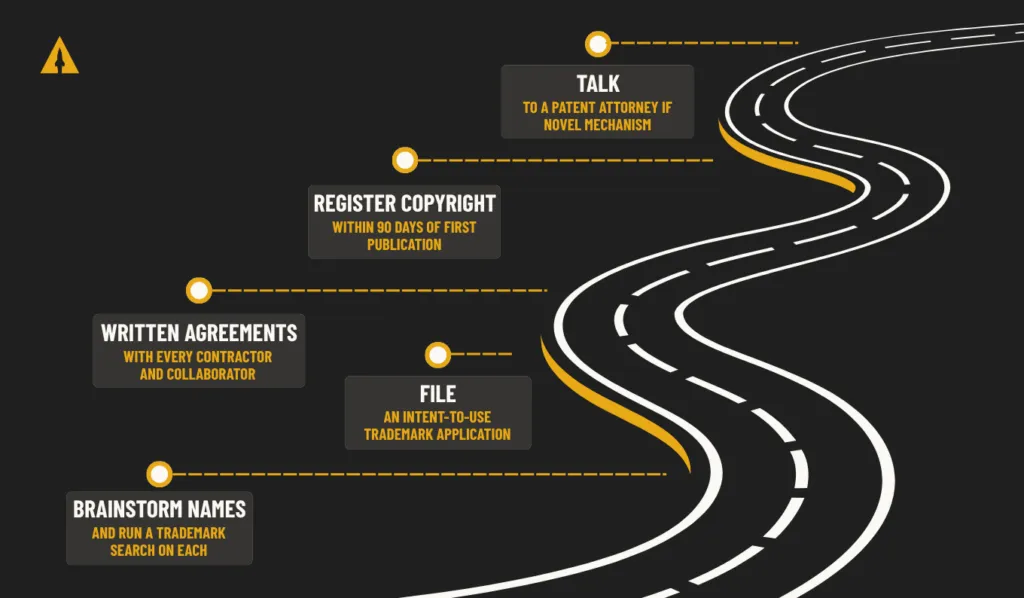
- Brainstorm several product and company names, then run a trademark clearance search on each one. Check USPTO, general search engines, and platform-specific searches relevant to your category.
- File an intent-to-use trademark application in the US to lock in your priority date before you start advertising. If you’re planning significant international sales, look into filing in those jurisdictions too, since many use first-to-file rules.
- Get written agreements with every contractor and collaborator. Artists, designers, musicians, anyone contributing to the box, the art, or the trailers. Make sure the agreement assigns rights to you, or if the contractor insists on retaining ownership, make sure the license you get is broad enough to actually use their work the way you need to.
- Register your copyright within 90 days of publishing the finished product, not necessarily the campaign launch date, unless the product is already complete when you crowdfund it.
- Talk to a patent attorney if there’s any hint of a genuinely novel mechanism or product design, and do it before you disclose the invention publicly.
Spending a few hundred dollars on this before you launch is a lot cheaper than fixing an infringement problem after the fact.
If you’re getting close to a launch and want a second qualified set of eyes on your pre-launch strategy, book a call with our team.
Board Game Law and Protecting Your IP: Frequently Asked Questions
How many candidate names should I run through a trademark clearance search?
Start with three to five. Trademark conflicts show up more often than most creators expect, and testing a single name means you’re back at square one if it turns out to be taken. Search the USPTO database, general web search, and any platform-specific search relevant to your category, like Board Game Geek for tabletop products. Having backups ready means a conflict costs you a day, not a month.
Do I need a trademark attorney, or can I file myself?
You can file a trademark application yourself through the USPTO, but a thorough clearance search catches conflicts that a basic self-search usually misses, including unregistered names that already carry some rights. An attorney also knows how close is too close: a plural or a minor misspelling of an existing mark usually isn’t different enough to avoid infringement. For a first product launch, a single consultation before you file is a reasonable middle ground.
Should I register copyright before or after my Kickstarter campaign launches?
Register within 90 days of publishing the finished product, not necessarily the campaign launch date. If your product isn’t finalized when the campaign goes live, wait until it is, then file. Filing late doesn’t cost you the ability to register, just some of the strongest remedies like statutory damages if you end up needing to enforce it.
Is it worth patenting a new game mechanic?
Rarely. Most game mechanics are variations on existing ideas, which makes them hard to qualify as patentable, and a full utility patent can cost $10,000 or more and take around three years. It’s worth exploring only if the mechanism is genuinely novel and central to your business, in which case a patent attorney consultation before you disclose anything publicly is the right first step.
What happens if I don’t lock down my trademark before launching?
You’re exposed during the gap between naming your product and actually shipping it. If a competitor starts using a similar name in that window and sells product first, they can gain priority over you, even if you thought of the name first. Filing an intent-to-use application before you launch closes that gap by locking in your priority date early.
