


Congratulations! The campaign you’ve been working on for months, maybe years, has gone live and was just fully funded. The money’s coming in, backers are excited, and it feels like the hard part is over. Now you just collect everyone’s shipping address with a pledge manager and get the product out the door… right?
That’s exactly the moment most creators inadvertently hand back a huge chunk of the money they just raised.
Konstantinos Manos, CEO of HIVE Interactive, a pledge manager built for crowdfunding, learned that the hard way. His first Kickstarter campaign raised $64,000. He lost about $40,000 of it in fulfillment. That loss is what pushed him to build HIVE Interactive, and after running 30 successful Kickstarter campaigns of his own since, he’s become one of the sharper voices on where post-campaign money actually disappears.
LaunchBoom’s own CEO Mark Pecota sat down with Konstantinos to walk through the five most expensive pledge manager mistakes he sees creators make, and how to avoid each one. If you want to hear it all straight from them, check out the video version of this guide:
Key Takeaways
- Small shipping errors don’t stay small. A $2 mistake per backer becomes a five-figure loss once you multiply it across thousands of orders.
- An “item” in your campaign and a “SKU” in your fulfillment hub are not the same thing, and mixing them up breaks everything downstream.
- Manually reformatting backer data for each fulfillment hub is a liability, not a workflow. One bad paste can misship hundreds of orders.
- Your post-campaign backer survey is a second checkout, not a formality. Treating it as one leaves real money on the table.
- Scattered post-campaign support (email, comments, DMs) guarantees dropped tickets and public complaints. Backers need one place to go.
Mistake 1: Getting Your Shipping Costs Wrong
The fastest way to lose your profit after a funded campaign is to miscalculate shipping, and it’s almost never one big obvious error. It’s a small misstep, multiplied by every backer you have.
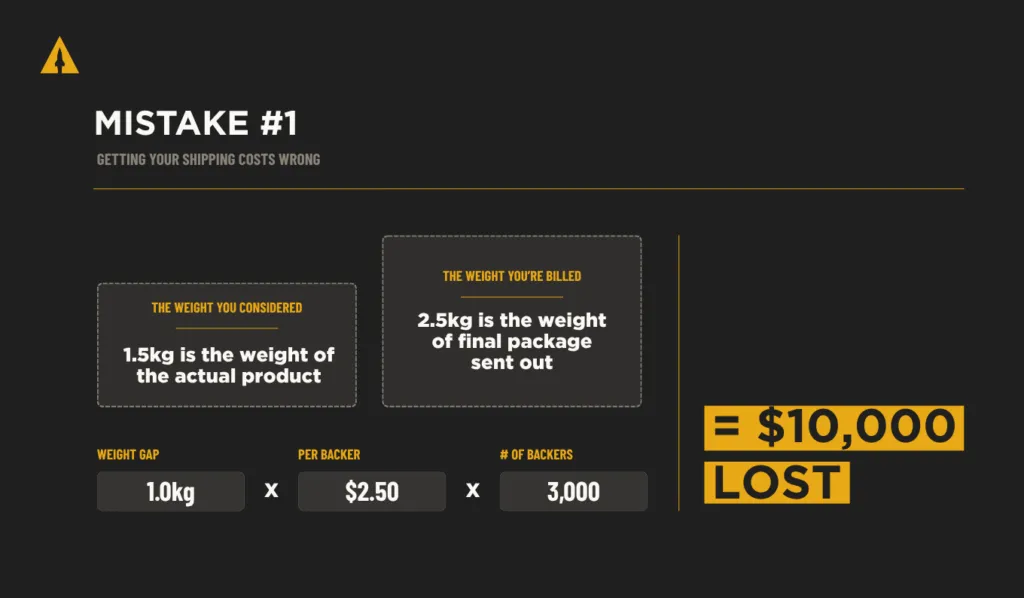
Two things slip through most often. The first is freight: creators pull per-unit prices from their fulfillment hub and forget what it cost to get the product to that hub in the first place. The second is volumetric weight, meaning the size of the box rather than just what’s inside it.
Konstantinos has watched this exact mistake sink margins over and over. He says,
They give to the hub 1.5 kilos of the game and they forget the volumetric. And the game is a weird box, or it has a game at its side, and then the volumetric becomes 2.5. Two, three bucks per backer, three thousand backers, you just lost 10K.
That gap does more than eat your margin. If you quoted backers $15 for shipping and now need to charge $25, you’re not just absorbing the difference. You’re absorbing it publicly, in the comments, from backers who feel like you pulled a bait and switch. The financial hit and the trust hit land at the same time.
Build your shipping estimates with freight and volumetric weight baked in from day one, and use a pledge manager that lets you set real shipping rules rather than flat rates that quietly eat your margin on oversized boxes.
Mistake 2: Confusing Items With SKUs
This mistake is sneakier, because you won’t see the cost until it’s already been baked into every number downstream.
When you build a campaign, you think in pledges and add-ons: a deluxe pledge, a stretch goal add-on, an upgraded box. Your fulfillment hub doesn’t think that way. It thinks in SKUs and barcodes, and plenty of pledge manager platforms let creators assume those two things line up when they don’t.
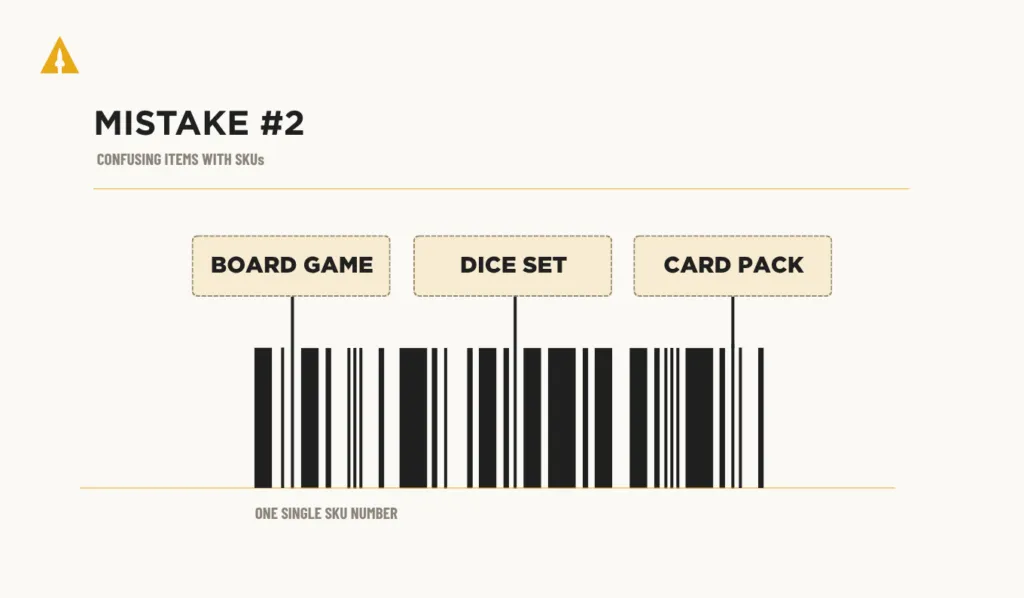
If you haven’t thought about SKUs just yet or if you don’t know what those even are, here’s a super simple explanation. A SKU (stock keeping unit) is whatever your fulfillment hub actually picks, packs, and tracks as a single physical unit, which often doesn’t match how you sold it in your campaign. Multiple pledge items can collapse into one SKU, and some items, like a small bundled freebie, may not count as a SKU at all.
Sometimes three separate items in your campaign ship as a single SKU. Sometimes an item in your campaign, like a small freebie tucked into the box, isn’t a SKU at all. Since your picking fees, storage costs, and support load are all calculated off SKUs, getting this mapping wrong means every number downstream is wrong too.
This trips up board game creators especially often, since a single deluxe pledge might bundle a rulebook, minis, and an expansion into one SKU, or leave a promo card out of the SKU count entirely. If protecting your components and IP is also on your radar heading into fulfillment, The Expert’s Guide To Protecting Your Board Game’s IP is worth reading alongside this guide.
As Konstantinos puts it, the confusion is more common than most creators realize.
People assume item and a SKU is the same thing, and it is not. Three items in my campaign might become one SKU. Some items in my campaign might not become a SKU at all.
Before you touch fulfillment, separate two questions clearly: what did backers buy, and what physically ships. Those are two different lists, and you want a pledge manager that lets you define your SKUs correctly, ideally one that flags the mismatch for you before it becomes a fulfillment problem.
Mistake 3: Manually Reformatting Backer Data for Every Hub
Here’s how most of the industry moves backer data to a fulfillment hub: export a giant CSV, open a spreadsheet, and start dragging columns around by hand until it matches whatever format that specific hub demands. Every hub wants something slightly different, so creators redo this dance from scratch each time.
That manual process is a time bomb. When you’re hand-editing a spreadsheet of thousands of orders, one wrong column or one bad paste doesn’t just cost you a single mistake. It costs you hundreds. According to Konstantinos, “paste a different item, you just shipped out 300 orders wrong. You’re done.”
Three hundred wrong packages out the door with no undo button immediately means refunds, reshipping costs, and a comment section on fire, all from one spreadsheet slip. If your fulfillment plan depends on you personally performing spreadsheet surgery under deadline pressure, that’s not a workflow but rather a liability waiting to happen.
The fix is to let software translate your data into each hub’s required format automatically instead of doing it by hand every time.
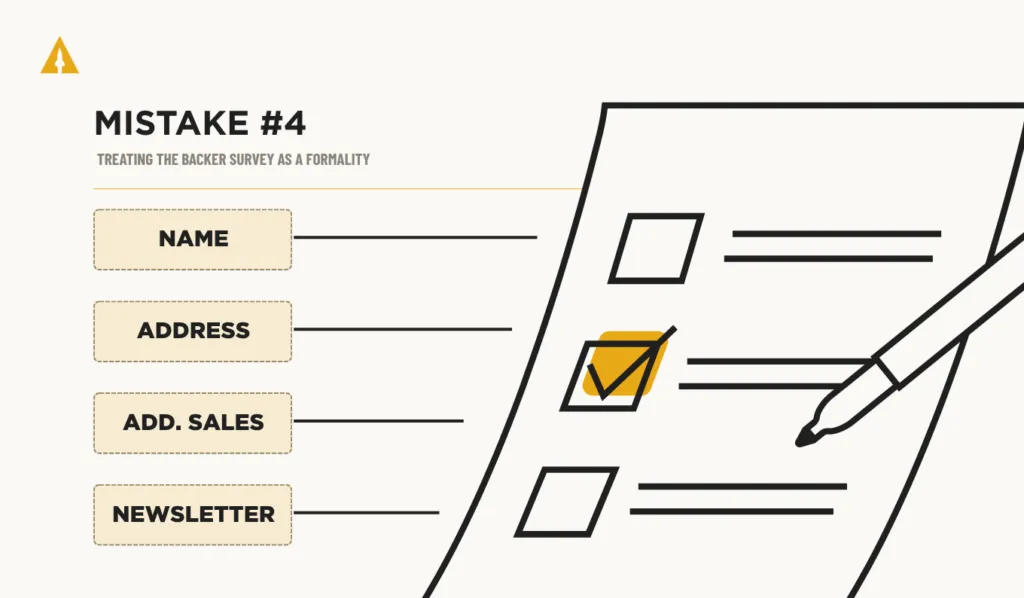
Mistake 4: Treating the Backer Survey as a Formality
After your campaign closes, every backer fills out a survey, usually just to confirm a shipping address and answer a couple of questions. To be quite honest, most creators treat it as a chore to get through. That’s a missed opportunity, because the survey is the single best sales moment you have left after the campaign ends.
Think about what you actually have at that point: a list of people who already pulled out their wallet for you, giving you more of their time and filling out a form. Asking for nothing but an address wastes that moment. A well-built survey filters questions based on what’s already in each backer’s pledge, then offers the right upgrade or add-on to the right person. As Konstantinos sees it,
A survey to just gather shipping information is not useful at all. If you use it correctly, you can easily get 10 to 15 bucks per backer up-sell.
Run that math across a few thousand backers and you’re looking at tens of thousands of dollars in revenue that costs nothing to generate. Your ad spend is already done and your campaign is already funded. Treat your survey like a second storefront, and personalize what you offer based on what each backer already bought.
This is also a good moment to start thinking past Kickstarter. Plenty of creators use a strong survey upsell to fund inventory for their next sales channel, and if that channel is Amazon, The Complete Amazon Playbook for Board Game Creators in 2026 is a useful next read once fulfillment is underway. (And yes, there’s plenty to learn there even if your product is in another category entirely!)
Mistake 5: Scattering Post-Campaign Support Across Too Many Channels
Fulfillment takes months, and across those months backers will have questions: where’s my order, can I change my address, why is my add-on missing… How you handle those questions shapes your reputation heading into your next campaign.
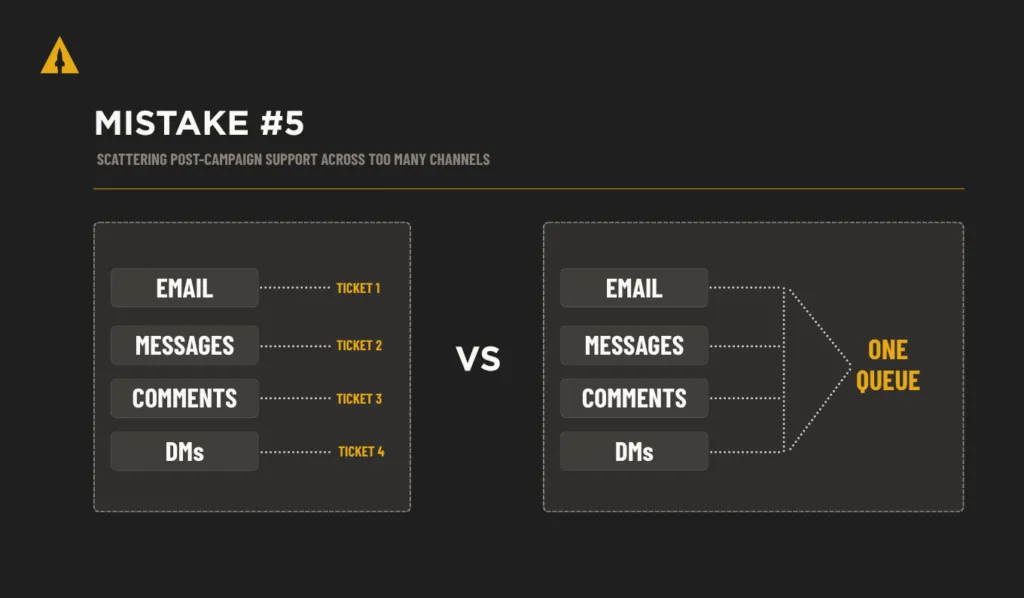
It’s also important to remember that usually, happy backers mostly stay quiet while unhappy ones tell everyone. That means your public comment section skews negative by default, and if your support is scattered across email, Kickstarter messages, campaign comments and DMs, tickets will fall through the cracks. Once you’re dealing with hundreds or thousands of backers, those dropped tickets multiply fast.
Emails end up in spam. You cannot prove that it was received or not. 99% of the comments are going to be the negative comments.
That’s the core problem with running support over email: you can’t prove a backer ever got your reply. It lands in spam, they assume you went silent, and now they’re posting about it publicly instead. The fix is a single source of truth, whether that’s a pledge manager with support built in or another dedicated ticketing system, so every question and answer lives in one place a backer can actually find.
Fulfillment logistics and packaging choices go hand in hand here too. If you haven’t locked in a manufacturer yet, find out how to find the right manufacturer before it sinks your campaign before you finalize any of the shipping assumptions above. Your manufacturer’s packaging decisions directly affect your volumetric weight.
If you’re heading into fulfillment and want help thinking through your pledge manager setup before backers start filling out surveys, you can talk to a LaunchBoom expert for guidance. Bring your current shipping and SKU plan, and we’ll help you find the gaps before they become expensive mistakes.
Frequently Asked Questions
How much does a shipping miscalculation actually cost on a typical campaign?
It scales directly with your backer count, which is what makes it dangerous. A $2 to $3 per-backer error across 3,000 backers works out to roughly $6,000 to $9,000 in lost margin, and that’s before accounting for the reputational cost of raising prices on backers after the fact. Always calculate freight to your fulfillment hub and volumetric weight separately from your per-unit product cost.
What’s the difference between an “item” and a “SKU” in my campaign?
An item is anything a backer can choose to pledge for or add on, while a SKU is whatever your fulfillment hub actually picks, packs, and tracks as a single unit. Multiple items can collapse into one SKU, and some items (like small bundled freebies) may never become a SKU at all. Map these out explicitly before you send anything to fulfillment, since picking fees, storage costs, and support load are all calculated per SKU.
Do I need a pledge manager, or can I just use a spreadsheet and email?
You can, but it puts you at serious risk once your backer count climbs into the thousands. Manually reformatting spreadsheets for each fulfillment hub and running support over email both create single points of failure where one mistake can misship hundreds of orders or lose a backer’s support request entirely. A dedicated pledge manager reduces that risk by automating hub-specific formatting and centralizing support in one place.
When should I send my post-campaign backer survey?
Send it as soon as your campaign closes and pledges are locked in, while backers are still engaged and thinking about their pledge. Filter your survey questions based on what each backer already selected, and use it as an opportunity to offer relevant upgrades or add-ons rather than only collecting a shipping address.
How many support channels should I actually use for post-campaign questions?
One. Pick a single official channel, whether that’s a pledge manager’s built-in support tool or a dedicated help desk, and route every backer question through it. Splitting support across email, Kickstarter comments, and DMs makes it nearly impossible to track what’s been answered, and a missed message on any one of those channels tends to end up as a public complaint instead of a private fix.
