



After a Kickstarter campaign ends, the money flow stops. Backers get their rewards, the campaign page goes quiet and the business still has to run on something. For a lot of tabletop creators, that something is Amazon and most of them end up having to figure it out with no real plan.
Mark brought in someone who deals with exactly this problem for a living: Jason Hsieh, chief toy officer at Toy Launch, an agency that runs Amazon marketing specifically for toy and board game brands.
Just like choosing the right crowdfunding marketing agency can make or break your campaign, it’s extremely important to have an expert handle the transition from Kickstarter to Amazon.
Jason Hsieh has launched hundreds of products in the space, and he knows everything there is to know about it. Before joining Toy Launch, he built his own toy company, LakiKid, after searching for suitable toys and tools for his son, who has autism and ADHD, and coming up short. He knows the platform from both sides.
What follows is Jason’s breakdown of the five levers that actually move sales on Amazon, the compliance work that has to happen before a listing goes live, and the margin math that decides whether a launch makes money or quietly loses it.
For the full session, including the live listing walkthroughs, watch our video with Jason on our YouTube channel:
Key Takeaways
- Get compliance sorted before anything else: a Children’s Product Certificate and safety testing from an approved lab aren’t optional for kids’ products, and Amazon will ask for both.
- Build the master keyword list early: it’s the foundation for listing copy, search optimization, and advertising, and skipping it means the algorithm has to guess what the product even is.
- Fully optimize the listing before running a single ad: title, bullets, images, video, A+ content, alt text, and backend search terms all feed the same algorithm that decides who sees the product.
- Match the review strategy to the product’s complexity: Amazon Vine works well for simple products and poorly for anything requiring real setup time.
- Run the margin math before setting a price: a 25% margin is the baseline, not the target.
- Track the paid-to-organic ratio: it tells you whether a product is still in launch phase, growing, or actually profitable.
- Reuse existing traffic: Email lists and ad creative from the Kickstarter campaign still have value on Amazon.
Why Amazon Is a Different Game Than Kickstarter
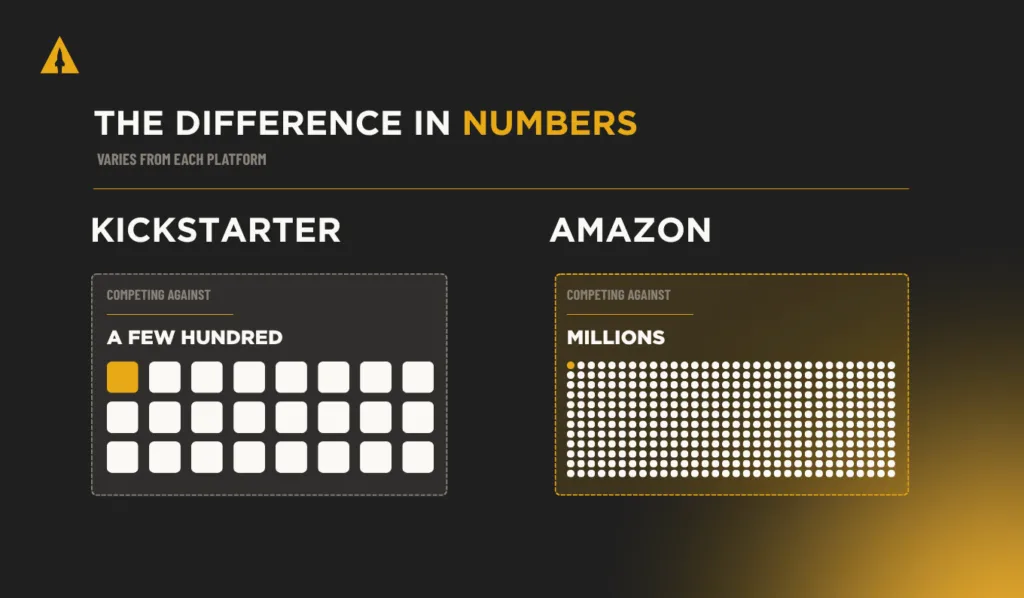
On Kickstarter, a project competes against a few hundred others in its category. Even if you already know all about how to advertise your game on Kickstarter, doing the same on Amazon is a whole other challenge.
On Amazon, that same product sits next to millions of listings, under a different fee structure and a different algorithm, with a completely different set of rules for winning attention.
Jason’s framework starts from a specific assumption: you already know how to think like a Kickstarter expert, and your Kickstarter campaign already worked. Maybe it raised $100,000. Maybe $200,000 or more.
The campaign is a project, not a business, so once it ends and fulfillment is underway, there still needs to be a channel that keeps revenue coming in. For most toy and game creators, that channel is Amazon.
Digital marketing on the platform comes down to three ongoing disciplines:
- Conversion optimization (getting the listing itself to do its job)
- Profit optimization (understanding exactly what Amazon takes before deciding what to spend)
- Ongoing optimization, since none of this is a set-it-and-forget-it exercise. It gets revisited weekly, sometimes daily.
Before You Launch: Compliance, Research and Branding
A few things need to happen before a listing ever goes live.
Compliance comes first, especially for kids’ products. Anything marketed to children under 13 needs a Children’s Product Certificate, which is a US legal requirement for importing children’s products, not just an Amazon policy. Amazon will also ask for product safety testing from an approved lab. Neither is difficult to get, but skipping it isn’t an option.
Market research and a buyer persona come next. Who’s actually buying this, what does the brand look like to them, and how does that compare to what’s already selling in the category?
Tools like Helium 10, Jungle Scout, and Data Dive pull data directly from Amazon’s API, making it possible to see what competitors are earning, how many reviews they have, and what their ratings look like before spending a dollar on ads.
Branding should carry over from the Kickstarter page. Same colors, same fonts, same visual identity, so a backer who later finds the product on Amazon recognizes it immediately.
An Amazon Storefront, essentially a mini website for the brand, is worth building once there are at least three products in the catalog. Below that, Jason doesn’t recommend spending much time on it.
The Five Levers That Move Sales on Amazon
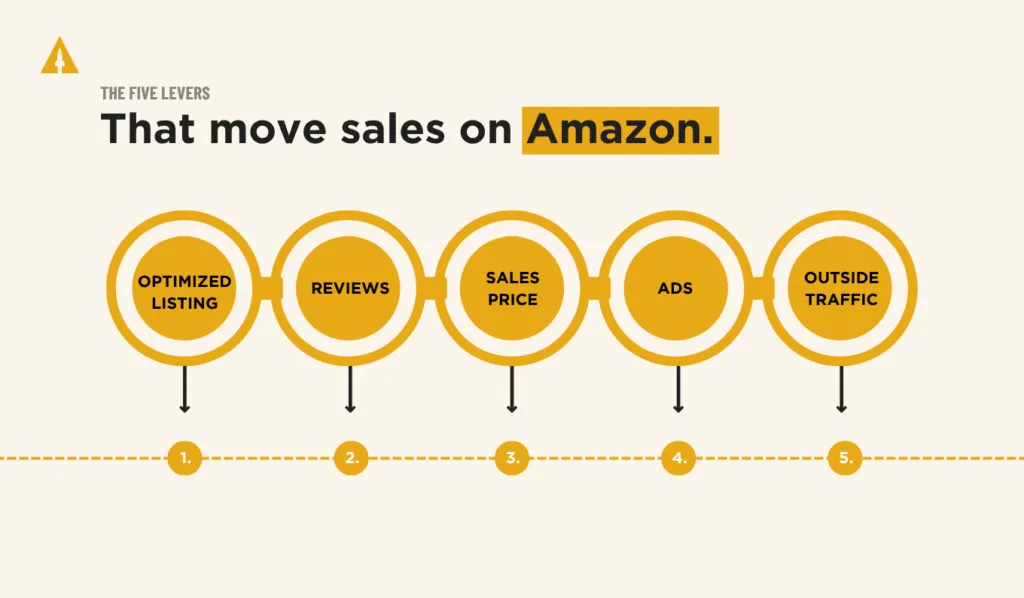
1. A Fully Optimized Listing
The product detail page is what every buyer sees before deciding to purchase, the same role the campaign page played on Kickstarter. Jason’s team treats a fully optimized listing as eight components, and getting through all of them properly takes 10 to 20 hours:
- Title: carries the heaviest weight for search engine optimization on Amazon
- Bullet points: five of them, keyword-rich, each explaining a real benefit or feature
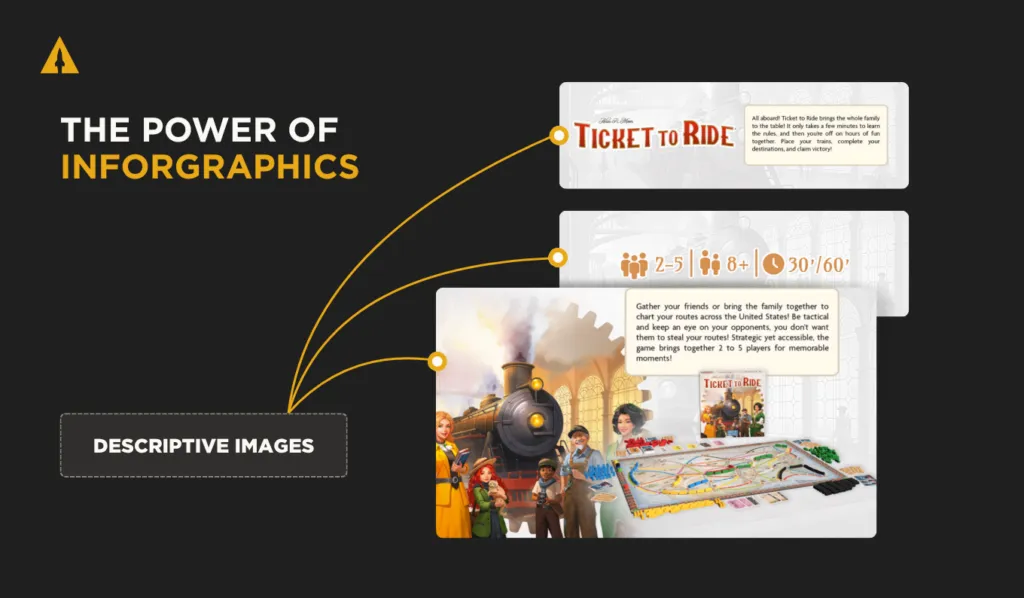
- Images: hero and secondary images, but critically, infographics as well
- Video: how-to-play clips, unboxing footage, influencer content, as much as reasonably fits
- Brand story: typically a horizontal banner establishing who made the product
- A+ content: an Amazon-hosted mini page, often built as a 4x4 grid of images, icons, and benefits
- Alt text: the search term field behind every uploaded image, frequently left empty by beginners
- Backend search terms: just under 250 bytes (about 250 characters) of additional keywords inside the seller account, also easy to forget
The images matter more than most creators expect. According to Jason, “About 80% of the consumer on Amazon, they don’t read. People are too lazy to read. I don’t read when I’m buying on Amazon. I only look at the images, or maybe watch one of the video, and say okay, this is what I want to buy.”
That’s the argument for infographics. A buyer scrolling past a listing needs to understand the product from the images alone, because most of them will never open the description.
2. Reviews
Amazon runs on comparison shopping, and a listing with no reviews gets no traction, regardless of how good the product is. Jason walked us through three ways to build that initial base:
- Amazon Vine. Up to 30 units enrolled for $200 per product (with cheaper tiers for fewer units), currently the easiest option. The catch: Vine reviewers tend to skip instructions. A client with a rulebook that took 30 minutes to read ran into a string of negative reviews because reviewers didn’t want to put in the time. Simple products under five minutes to understand are a good fit for Vine; complicated ones are a gamble.
- Third-party review automation, through tools like Helium 10 or Jungle Scout, which use Amazon’s API to request reviews from verified buyers automatically.
- An ambassador approach with influencers already in the brand’s network, asking them to check out the Amazon listing and leave an honest review.
The benchmark is at least 10 reviews as early as possible.
As tempting as it might be, don’t ask friends or family to help out with this point. Amazon tracks IP addresses and social connections closely enough to flag review manipulation, so requests should go to people without a direct, visible tie to the brand.
3. Sales Price
Pricing on Amazon needs to stay consistent with whatever backers paid on Kickstarter. A common approach is a small discount during the first 30 days, but only after margin has been calculated, and only if it doesn’t undercut what backers already paid.
4. Advertising
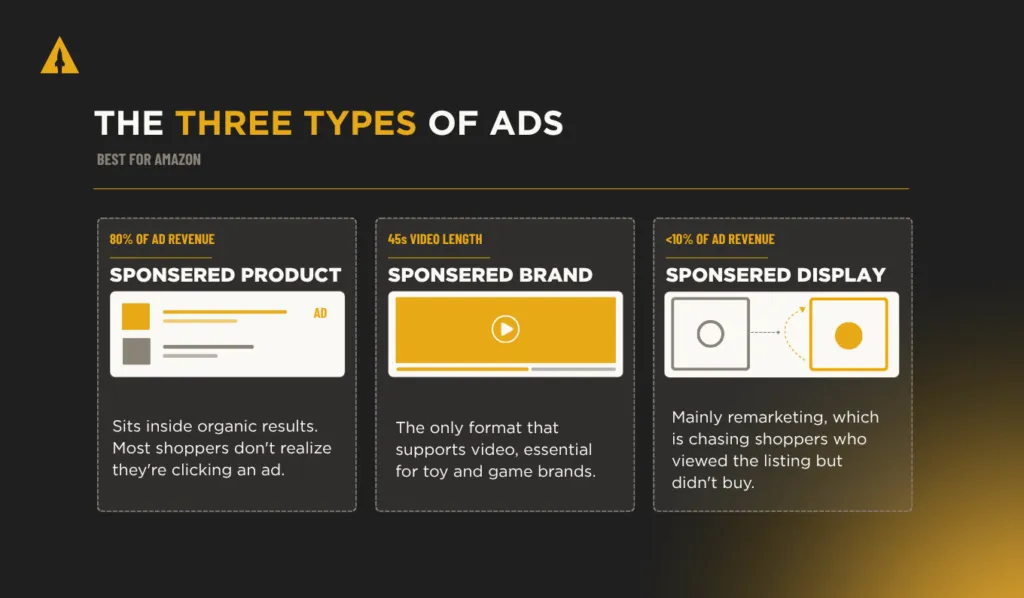
Amazon today is pay to play. Without ads, a new listing doesn’t surface. Jason covered three core ad types:
- Sponsored Product: the ad format disguised inside organic search results, driving roughly 80% of advertising revenue because most shoppers don’t realize they’re clicking an ad. No creative control here; Amazon pulls directly from the listing’s own images.
- Sponsored Brand: the format that supports video ads, which Jason called essential for toy and game brands specifically. He recommends keeping these under 45 seconds, built as a fast-paced teaser of gameplay.
- Sponsored Display: typically under 10% of ad revenue, used mainly for remarketing to shoppers who viewed a listing but didn’t buy.
A full campaign setup usually includes at minimum: two auto campaigns (keyword and product-based), four category campaigns (broad, phrase, exact, and category match), two competitor campaigns (product and brand name), and a branded defensive campaign protecting the brand’s own name. That’s roughly 10 campaigns per product, so a three-product catalog should have at least 30 running.
5. Outside Traffic
Email lists and social followers built during a Kickstarter campaign don’t stop being useful once the campaign ends. Someone who joined a list but never backed the project might still convert on Amazon months later, and Amazon’s A9 algorithm treats traffic arriving from outside the platform differently than traffic that finds a listing natively, often rewarding it. The same Meta ad creative and email sequences used for the campaign can simply be redirected toward the Amazon listing.
Understanding Your Margin First
None of the above works if the margin math doesn’t hold up. Jason recommends running every product through the free Amazon Revenue Calculator before committing to a launch: product dimensions, weight, category, and item price go in, and the tool returns every FBA fee that applies.
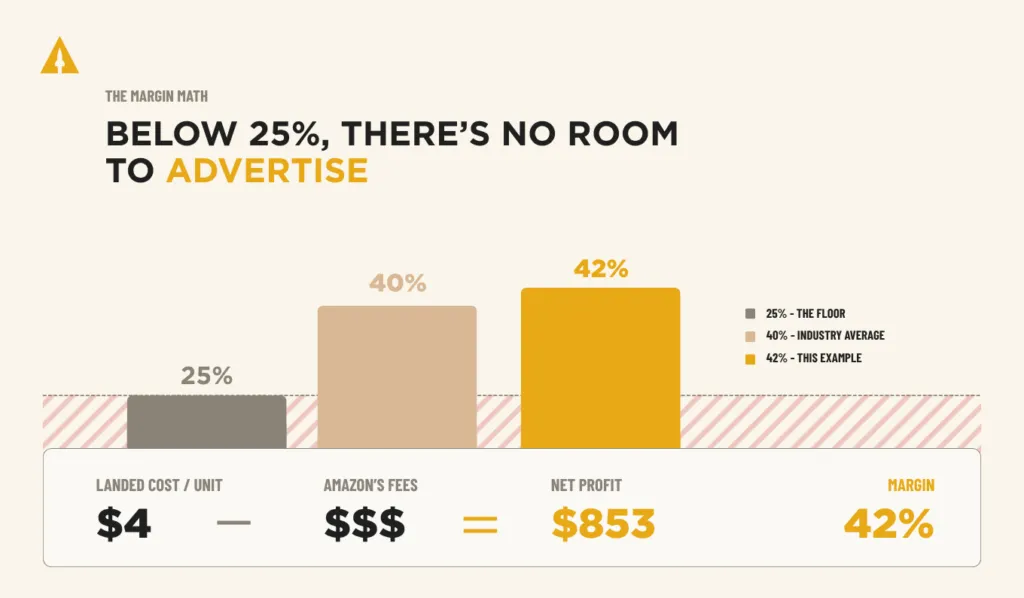
In a live example using $4 in landed cost per unit, the calculator showed $853 in net profit after Amazon’s fees, working out to roughly 42% margin. Jason’s benchmark: 25% is the minimum to sustain advertising and ongoing costs, and the toy and game industry average across the hundreds of products his team has launched sits around 40%. Anything below 25% doesn’t leave enough room to advertise, let alone grow.
The Three Phases Every Product Goes Through
Every Amazon listing moves through the same three stages, and the split between paid and organic revenue is the clearest signal of which stage a product is in:
- Launch phase: close to 100% of revenue comes from ads
- Growth phase: roughly 20 to 30% organic, 70% paid
- Profitability phase: closer to an even split, with organic revenue matching or exceeding paid
Unlike Meta, where turning off ads drops sales to zero overnight, a well-ranked Amazon listing keeps generating some organic sales even with ads paused. Jason’s team still never recommends cutting ads entirely; that ranking erodes gradually rather than instantly, but it erodes.
Influencer partnerships can add meaningful volume at low cost. One client campaign spent $200 on Amazon’s influencer program and generated $1,100 in return, a strong ratio for a fairly small effort.
Timing the Launch
Getting inventory into an FBA warehouse, finishing listing optimization, clearing compliance, and setting up advertising all take time. Jason’s minimum recommendation is two months of runway before a launch date, though more is always better. Kickstarter campaigns often get six to nine months of planning; Amazon needs less, but not much less.
Jason went from a single founder’s personal need to joining a company that handles hundreds of product launches across the toy and game space, and the pattern holds across all of them: the businesses that survive past Kickstarter are the ones that treat Amazon as its own platform, with its own rules, rather than a place to just relist what already worked somewhere else.
If you’re heading into Amazon after a campaign, start with the compliance checklist and the margin calculator before touching a single ad. Everything else builds on those two.
And remember, Jason’s playbook assumes a successful Kickstarter behind it. If you’re still working toward that part, our team can help you build the pre-launch and campaign strategy that gets you there in the first place. Book a free call with a LaunchBoom strategist to chat about your project.
Selling on Amazon for Board Game Creators: Frequently Asked Questions
How is selling on Amazon different from selling on Kickstarter?
Kickstarter and Amazon serve different purposes, so you can’t treat one as an extension of the other. Kickstarter is built for launching and funding a project, while Amazon is an ongoing sales channel with its own search algorithm, advertising system, fees, and compliance requirements. Even if your Kickstarter campaign succeeds, you still need a separate strategy to keep selling on Amazon once the campaign ends.
What do you need to do before launching your product on Amazon?
Start with compliance, market research, and branding. If you’re selling a children’s product, handle safety testing and get your Children’s Product Certificate before launch, not after. Research your competitors, define your buyer persona, build your keyword list, and make sure your Amazon branding matches what customers already saw during your Kickstarter campaign.
Do you need safety testing and a Children’s Product Certificate for a children’s product?
Yes. If you’re marketing to kids under 13, you’ll need to meet US children’s product safety requirements, including testing and certification. Amazon may also ask for documentation before it lets your listing stay live. Handle this compliance work before launch, since waiting until after can get your listing suspended.
How important are keywords for an Amazon product launch?
Keywords come first, before you write your listing or set up advertising. Build your master keyword list, then use it to shape your title, bullet points, image alt text, backend search terms, and ad campaigns. Without a clear keyword strategy, Amazon has less information about which searches should surface your product, and you’ll struggle to get found.
How many Amazon reviews do you need before your product gains traction?
Aim for at least 10 legitimate reviews as early as possible. Amazon Vine, review-request tools that comply with Amazon’s policies, and an ambassador strategy can all help you get there. Don’t manipulate reviews or ask friends and family to leave them. Amazon can suspend your listing for that, and it’s not worth the risk.
Is Amazon Vine a good option for every product?
No. Vine works best for simple products that reviewers can understand and use quickly. If your product requires lengthy setup or complicated instructions, reviewers may not invest the time to use it properly, and you’ll end up with weaker reviews. Weigh your product’s complexity before you lean on Vine as a review strategy.
How should you price a product on Amazon after a Kickstarter campaign?
Start with your actual margin, not with what competitors charge. Factor in Amazon fees, landed product cost, advertising, and other operating expenses before you set your retail price. If you’re running a launch discount, keep it consistent with what your Kickstarter backers paid, and make sure it still leaves you enough margin to advertise and grow.
How much profit margin should an Amazon product have?
Treat 25% as your minimum benchmark for sustaining advertising and ongoing costs. The stronger your margin, the more room you’ll have to grow. Calculate your actual Amazon fees and landed costs before you commit to a price or advertising budget, since the right target depends on your specific product and business model.
Do you need Amazon ads to launch a new product?
Yes. Paid advertising matters for new Amazon listings because a new product starts with little organic visibility. Sponsored Products, Sponsored Brands, and Sponsored Display each serve a different purpose, from capturing search demand to promoting video to remarketing to shoppers who viewed your product but didn’t buy.
What types of Amazon ads should you use?
Build a mix that covers all three: Sponsored Product campaigns for search and product targeting, Sponsored Brand campaigns for brand and video promotion, and Sponsored Display campaigns for remarketing. The right combination depends on your product, budget, competition, and stage of launch, so revisit the mix as you learn what’s working.
Can you use your Kickstarter email list to drive Amazon sales?
Yes. Your Kickstarter audience stays valuable after the campaign ends. People who joined your email list but didn’t back your project can still become Amazon customers later. Reuse your campaign email sequences, social audiences, and ad creative to send qualified traffic to your Amazon listing instead of building everything from scratch.
How long does it take for an Amazon product to become profitable?
Expect to move through three stages: launch, growth, and profitability. Early sales usually depend heavily on paid advertising, but as your listing gains reviews, conversions, and organic ranking, more of your revenue will come from unpaid search. Track your paid-to-organic sales ratio to see which stage you’re actually in.
How far in advance should you prepare for an Amazon launch?
Plan for at least two months of runway before your target launch date. That gives you time to get inventory into Amazon’s fulfillment network, finish compliance work, optimize your listing, build advertising campaigns, and fix problems before customers show up. If your product is more complicated, budget even more lead time.
Should you build an Amazon Storefront for your brand?
Build one once you have multiple products worth showcasing. A Storefront creates a dedicated shopping experience within Amazon, and it becomes more valuable as your catalog grows. If you only have one or two products, put that effort into optimizing your listing instead.
What’s the biggest mistake crowdfunding creators make when moving from Kickstarter to Amazon?
Treating Amazon like an extension of Kickstarter instead of a new sales channel. Your campaign gives you an audience and creative assets, but Amazon requires its own approach to compliance, keywords, listing optimization, reviews, pricing, advertising, and profitability. Build that strategy before your campaign ends, and you’ll have a much better shot at turning crowdfunding momentum into ongoing revenue.
