

If you’ve ever watched a Kickstarter campaign blow past its goal in the first few hours, you weren’t watching luck, magic or any other roll of the digital dice that makes campaigns succeed at random. You were witnessing a proven system at work.
LaunchBoom’s CEO Mark Pecota calls that day-one spike a “launch boom”: it’s the company’s namesake and the strategy behind every campaign LaunchBoom has helped fund over the past 13 years.
To help future creators get the full picture of the framework, we broke the whole system down into seven steps, from positioning your product to sending the two emails that matter most on launch day.
Before we dive in, if you’d rather hear it all from Mark himself, here’s the video version of this guide:
Key Takeaways
- A fast start on Kickstarter isn’t a nice-to-have. It unlocks free platform traffic, boosts your conversion rate, and makes you more newsworthy.
- Good product positioning solves more launch problems than good design does. Most failed campaigns had a positioning problem, not a product problem.
- A $1 reservation deposit tells you who’s actually going to buy, long before you spend a dollar on ads.
- Your campaign page and video both live or die on the words, not the visuals. Write the copy and script before you touch design.
- Save your best offer for a small, engaged VIP list, and let their early pledges build the social proof that convinces everyone else.
Why Funding Fast Actually Matters
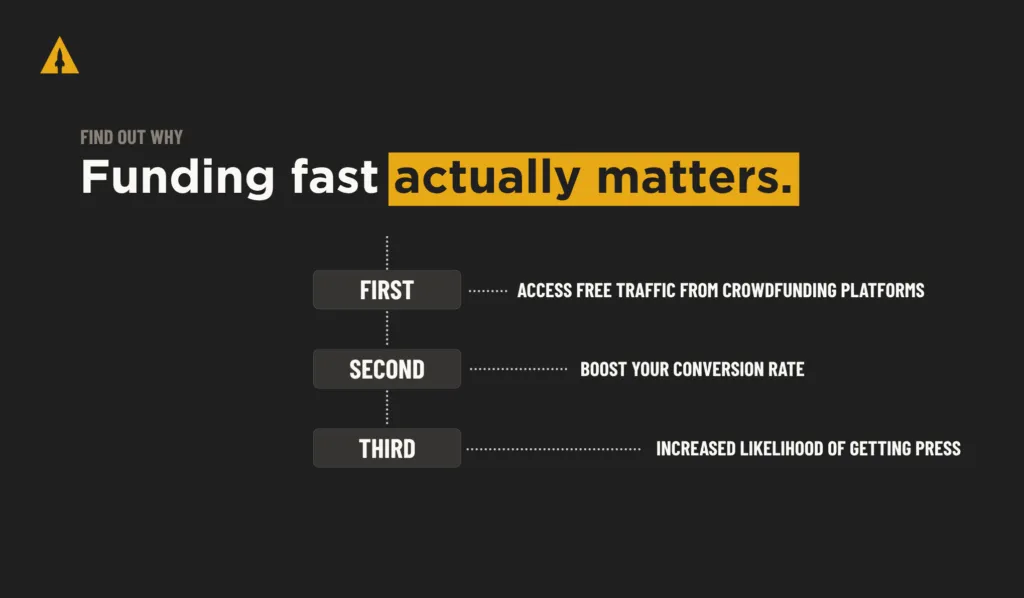
Before you get into the how, it’s worth understanding the why. You might assume it doesn’t matter much whether your funding comes in on day one or spreads evenly across your campaign. Mark’s data says otherwise, and he points to three specific benefits.
First, funding quickly gets you free traffic from the platform itself. Kickstarter alone has 26+ million backers, and projects that rank higher get more of their eyes. Sphinx, one of LaunchBoom’s clients, raised over $555,000 on Kickstarter, and $110,000 of that (19%!) came directly from Kickstarter’s own traffic, a direct result of ranking well early.
Second, it boosts your conversion rate. A backer is far more likely to pledge to a campaign that’s 334% funded than one sitting at 8%. Momentum builds trust, and trust converts.
Third, it makes you more likely to get press. Reporters need a story, and “this campaign blasted through its goal” is a story. A fast start is often the difference between a write-up and a pass.
With that context in mind, here’s the seven-step system:
Step 1: Nail Your Product Positioning
Mark opens with a stat worth sitting with: about 57% of Kickstarter campaigns fail (as of January 2026, when Kickstarter retired its stats page). A lot of those weren’t bad products. They had bad positioning.
LaunchBoom uses a framework called Consumer-Based Brand Equity (CBBE) to work through positioning, and it’s built on one idea: your brand doesn’t live in your head, it lives in your customer’s. So you build it by thinking like them, working through four layers.
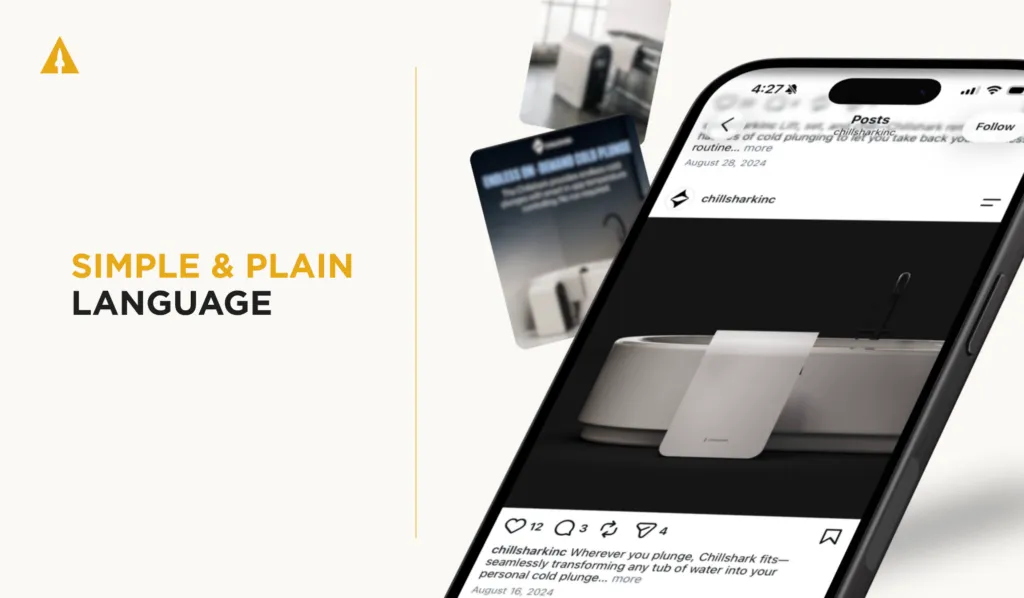
Salience answers the simplest question: what are you? Don’t overthink this layer. LaunchBoom client Chillshark, which raised $439,000, didn’t call itself a “cryotherapeutic immersion system engineered for optimal personal recovery.” It called itself “your at-home cold plunge solution.” Simple, plain language wins.
Performance and imagery answers how you do it and where you fit into someone’s life. Xebec Snap positioned around a clear differentiator, calling itself the “world’s first portable monitors that instantly snap onto your laptop.” A client selling a smart e-ink display, Inku Calendar, thought through exactly where the product would live: a nightstand, a desk, a living room. That thinking shapes every photo you’ll take later.
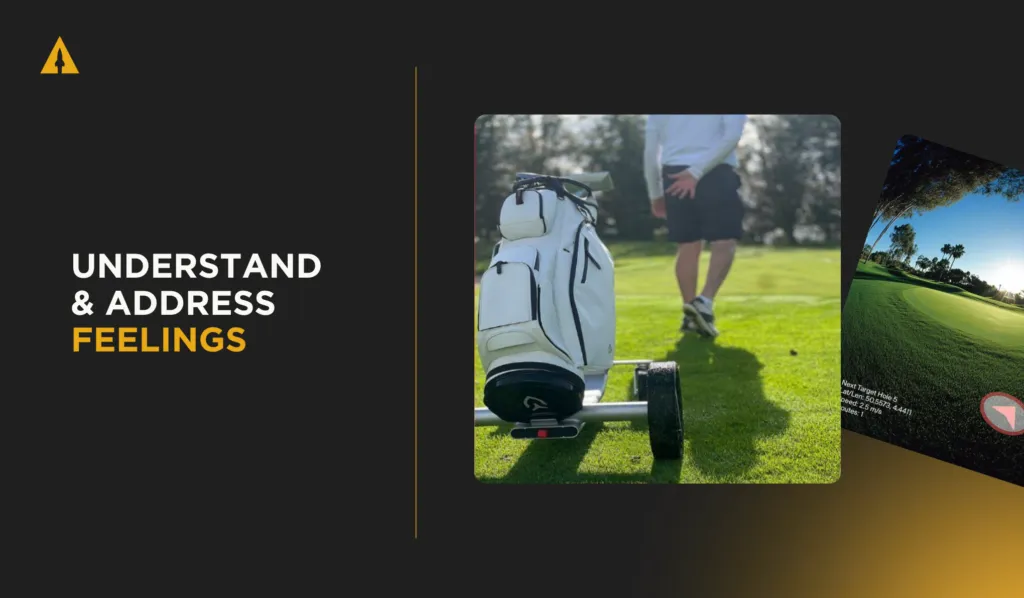
Judgments and feelings get at how good you are and how you want people to feel. The team behind iXi, an autonomous golf trolley that raised $879,000, anticipated the doubts backers would have (“Can it really follow me?” “Can it climb a hill?”) and built imagery that answered those doubts directly.
Resonance is the deepest layer: does this brand’s mission line up with mine? The founders behind Legends of Avantris are lifelong D&D players who stream their games live, and their campaign for The Crooked Moon raised $4 million in part because their faithful audience recognized itself in them.
Step 2: Capture the Right Product Imagery
Once your positioning is set, it should tell you exactly what to photograph. Mark breaks product imagery into three categories.
Studio shots are your glamour shots, either whole-product images from straight-on, 45-degree, profile, and back angles, or close-up feature shots (usually two to five, more if you have more features to show).
Location shots put your product in the environment it’s meant to live in. If your positioning work already answered “where will this be used,” this step is mostly execution.
Action shots show motion or interaction, whether that’s a GIF, a short video, or a stylized photo of someone actually using the product.
Getting this stage right takes real technical care, especially if you’re relying on renders instead of physical prototypes. If that’s you, understanding the 5 mistakes that make your 3d product renders suck (and how to fix them) before you start shooting will help you avoid fixing problems after the fact.
Step 3: Build a Reservation Funnel
This is the step Mark says changed everything for LaunchBoom.
In the early days, their funnel was simple: an ad, a landing page, an email signup, a thank-you page. The problem was that an email address tells you almost nothing about whether someone will actually buy. In those early days, LaunchBoom built email lists that looked great and then watched no one show up on launch day.
The fix was adding just one step. After someone gives their email, they land on what LaunchBoom calls a reservation bridge: an offer to put down a refundable $1 deposit to lock in the best deal or an exclusive bonus. That single step splits your list into two groups. Non-VIPs only gave an email. VIPs put money down.
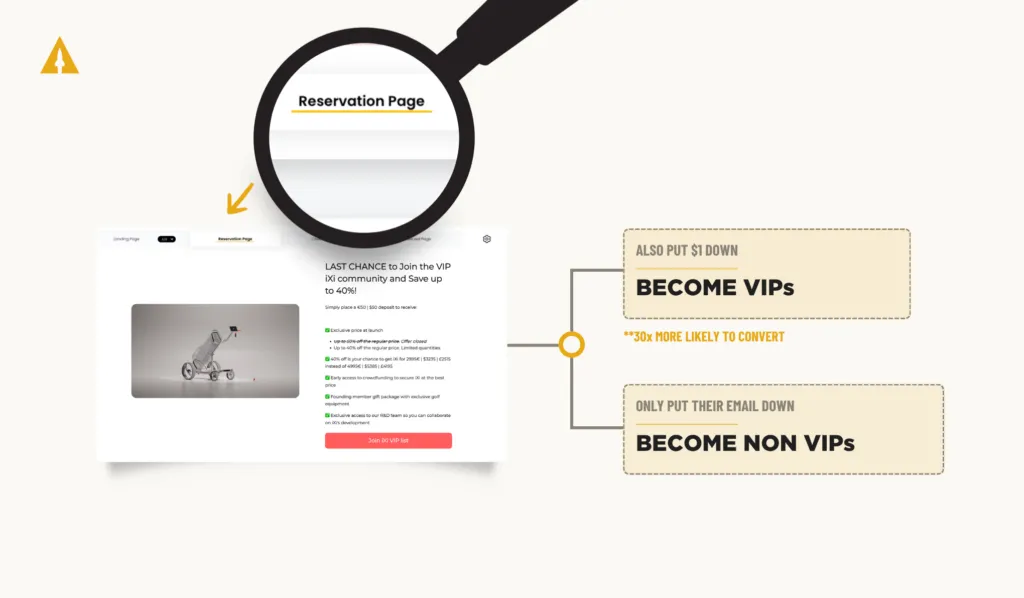
That distinction matters more than you’d think. There are numbers that really back up why the $1 reservation pre-launch strategy helps both backers and creators.
LaunchBoom’s data shows VIPs are 30 times more likely to buy than someone who only gave an email address.
Step 4: Get Your Ads Live
Once your funnel exists, you need traffic to send to it, and Mark is direct about where that traffic should come from: Meta ads. Despite years of speculation about TikTok, Reddit, or X taking over, Meta still drives the most qualified leads for crowdfunding specifically.
For targeting, LaunchBoom still leans on narrow, interest-based audiences rather than Meta’s broader automated targeting, at least for crowdfunding campaigns. To build those audiences, Mark uses a “4 Fs” framework: who does your audience follow, where do they frequent, what do they do for fun, and what do they fund.
LaunchBoom client The Scoop, which raised $256,000 on Indiegogo, built an audience around specific media personalities its buyers followed, plus interests like HGTV, Food Network, and AARP-adjacent retirement planning content.
It’s also worth layering in a general crowdfunding and Kickstarter interest audience on top of whatever niche interests you find. Our ultimate Kickstarter course goes over ads further if you need guidance on that front.
For the ad itself, eye-tracking data shows people look at the image or video first, so that’s your highest-leverage asset. From there, a bold claim headline, a short list of features and benefits, and a clear call to action (“reserve now for exclusive VIP pricing”) is a formula that still converts.
Step 5: Build Your Campaign Page
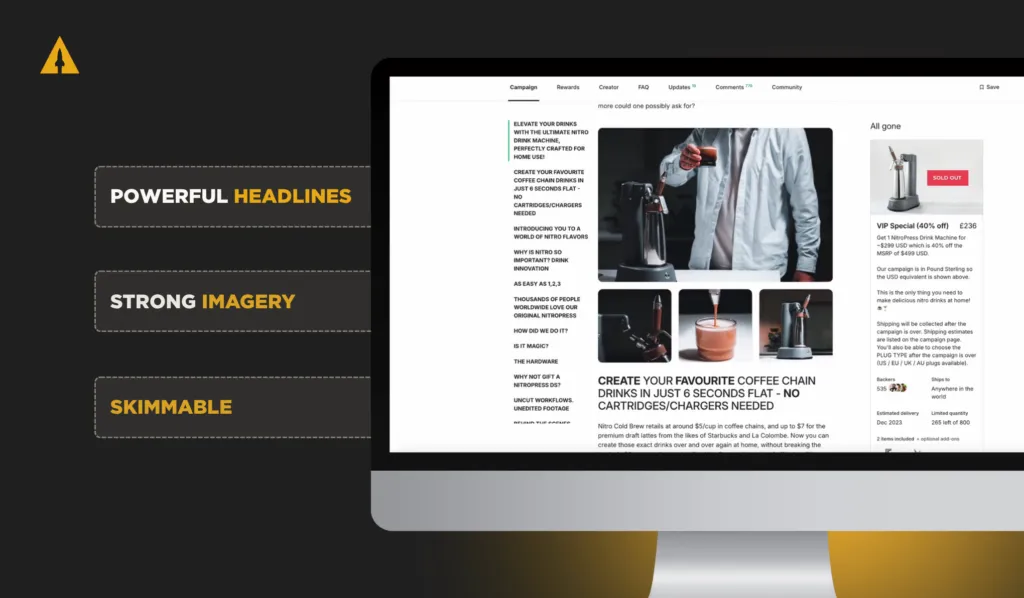
When it comes to creating a Kickstarter campaign page that converts, Mark gives three great tips, and the first one is the one people skip: copy comes before design. Write your full page copy, headline through FAQ, in a plain document before anyone touches a design tool. The best visuals on your page won’t save weak copy.
Second, use your pre-launch data to inform your design. If you tested hero images and copy through your ads and funnel, you already know what resonates. Use it.
Third, model what works. Crowdfunding campaigns are public, so study the best-performing pages in your category and understand what they’re doing before you build your own.
Above all, design for skimmability. Most visitors scan rather than read, so your headlines alone should communicate your core benefit and who the product is for, backed up by supporting imagery.
Step 6: Create Your Campaign Video
The same principle as the campaign page applies to Kickstarter video production: how to create a high-converting crowdfunding video: script first, design second. Mark’s other two tips are just as direct.
Don’t tell your story, sell your product. It’s tempting to make your campaign video a mini-documentary about your founder journey, but Mark is clear that the video’s job is to convert, not to entertain.
And don’t overspend. A first-time creator can put together a strong campaign video for under $10,000. One LaunchBoom client, Scott, made his for about $2,000, professional cat model included, and went on to raise $468,000.
Step 7: Launch and Build Your Day-One Spike
Here’s where the first six steps come together. Before you launch, send exactly two emails to your list: one seven days out, one the day before. Mark’s found that sending more than that trains people to stop opening your emails altogether, which is the opposite of what you want on launch day.
On launch day itself, send two more emails, one in the morning and one in the evening. The morning launch email goes out in a specific order. Notify your VIPs first. Remind them their deal is exclusive, and post in whatever private group (Facebook or Discord) you’ve built for them.
Wait an hour, then send the same launch email to your non-VIP list. Letting VIPs fund the campaign first gives non-VIPs social proof and a funded project to back, which meaningfully increases how many of them convert. In the evening, send one reminder email to your whole list.
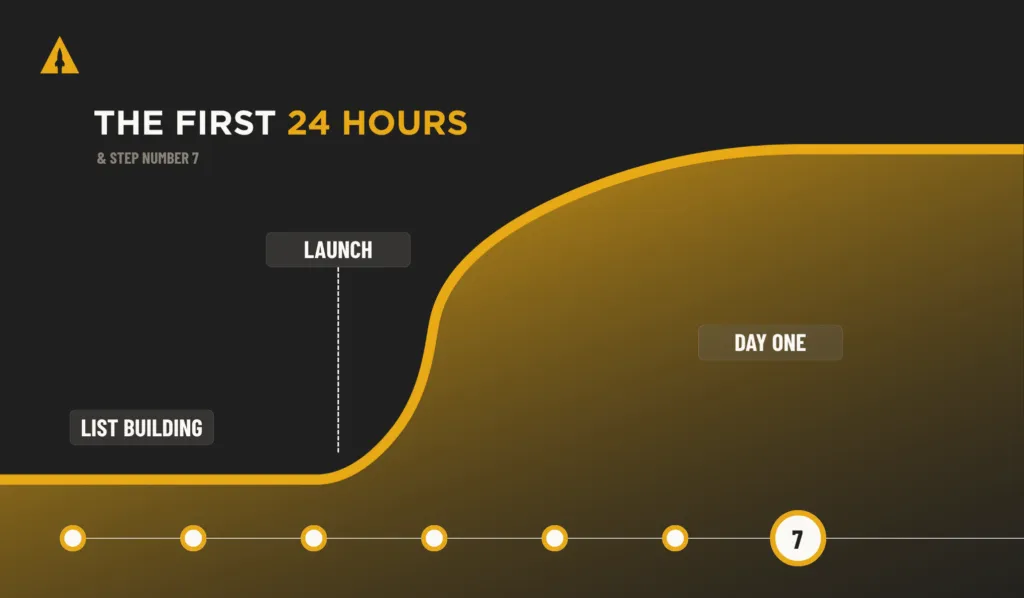
Done right, this sequence produces the graph LaunchBoom is named for: a steep spike in funding on day one. It’s the same pattern behind client results ranging from $124,000 to $1.7 million, and it starts with the same seven steps every time.
If you’re working through any of these seven steps and want a second set of eyes on your strategy, LaunchBoom’s team can help. Book a call, tell us where you are in your pre-launch, and we’ll help you figure out the next specific step to take.
Frequently Asked Questions
How much should I spend building my email list before launch?
There’s no fixed number, since it depends on your ad costs and category, but the more important metric is quality over volume. A smaller list of reservation deposits (VIPs) will outperform a much larger list of email-only leads, since VIPs convert at roughly 30 times the rate. Focus your ad spend on generating deposits, not just cheap email signups.
Do I need a $1 deposit, or can I just collect emails?
You can collect emails alone, but you’ll be launching mostly blind. Email-only signups don’t tell you who’s actually going to pledge, which makes it hard to predict your funding and easy to overspend on ads that generate low-quality leads. The $1 deposit step is what turns an email list into a reliable revenue forecast.
How many product photos do I actually need for my campaign page?
Plan for a mix across all three categories: a handful of studio shots (both whole-product angles and 2 to 5 feature close-ups), several location shots showing the product in real use, and at least one or two action shots or GIFs. Ten to twenty total images is a reasonable range for most campaign pages, depending on how many features you’re highlighting.
Is it too late to build a reservation funnel if I’m launching soon?
It’s better to have even a short pre-launch window than none at all, since a reservation funnel run for a few weeks still gives you VIP data you wouldn’t otherwise have. That said, the earlier you start, the more time your ads have to find and refine your best-performing audiences, so don’t wait until the last minute if you can help it.
Should I keep emailing my list in the weeks before launch to build excitement?
Resist the urge. Sending more than two pre-launch emails tends to train subscribers to stop opening them, which works against you on launch day when you need those opens most. Stick to one email seven days out and one the day before, and save your momentum for the two emails you send on launch day itself.
