


Nowadays every contemporary crowdfunding launch leans heavily on 3D product renders. Most of those renders just aren’t very good, and that can affect the success of those launches. At LaunchBoom, we’ve helped over 1,000 founders raise more than $200 million through crowdfunding, and the same five render mistakes show up again and again.
To break them down and learn what founders can do better, we called on a product render expert to give us the crash course on what makes renders shine. Enter Gianluca Gabrielli, founder of IAS Creative, whose team has produced renders for some of the biggest crowdfunding launches around.
His advice boils down to five aspects that affect the quality and effectiveness of your renders and your campaign as a result.
If you’re more of a visual learner yourself, you can watch the video version of Gianluca’s render tips here:
Key Takeaways
- Judge a render artist by their lighting, materials, and textures. That’s 80% of what separates a render that looks real from one that reads as generic CGI.
- Give every render a job in the story. If it doesn’t map to a beat in Gianluca’s six-beat framework, it’s not earning its place.
- Mix CGI, real photography and hybrid instead of picking one. Each style covers a need the others can’t.
- Validate before you build out a full library. A couple of hero renders and a short teaser will tell you if the concept works before you spend the full budget.
- Use AI to brief your artist, not to replace one. AI is a sketchpad for your vision. Entrust the finished renders to an experienced artist.
Bad Lighting, Materials, and Textures
According to Gianluca, 80% of what makes a render “good” comes down to three things: materials, textures, and lighting. “Materials, textures, lighting, those are the three main players in the rendering game.”
Get any one of those wrong and a render stops looking real. It just looks off, almost uncanny, and shoppers pick up on that even if they can’t say why.
Let’s look at two renders of the same pair of sunglasses. In the weaker version, there’s no realistic shadow or reflection. Nothing grounds the product in a real space. In the strong version, you can see exactly where the light is hitting the frame.
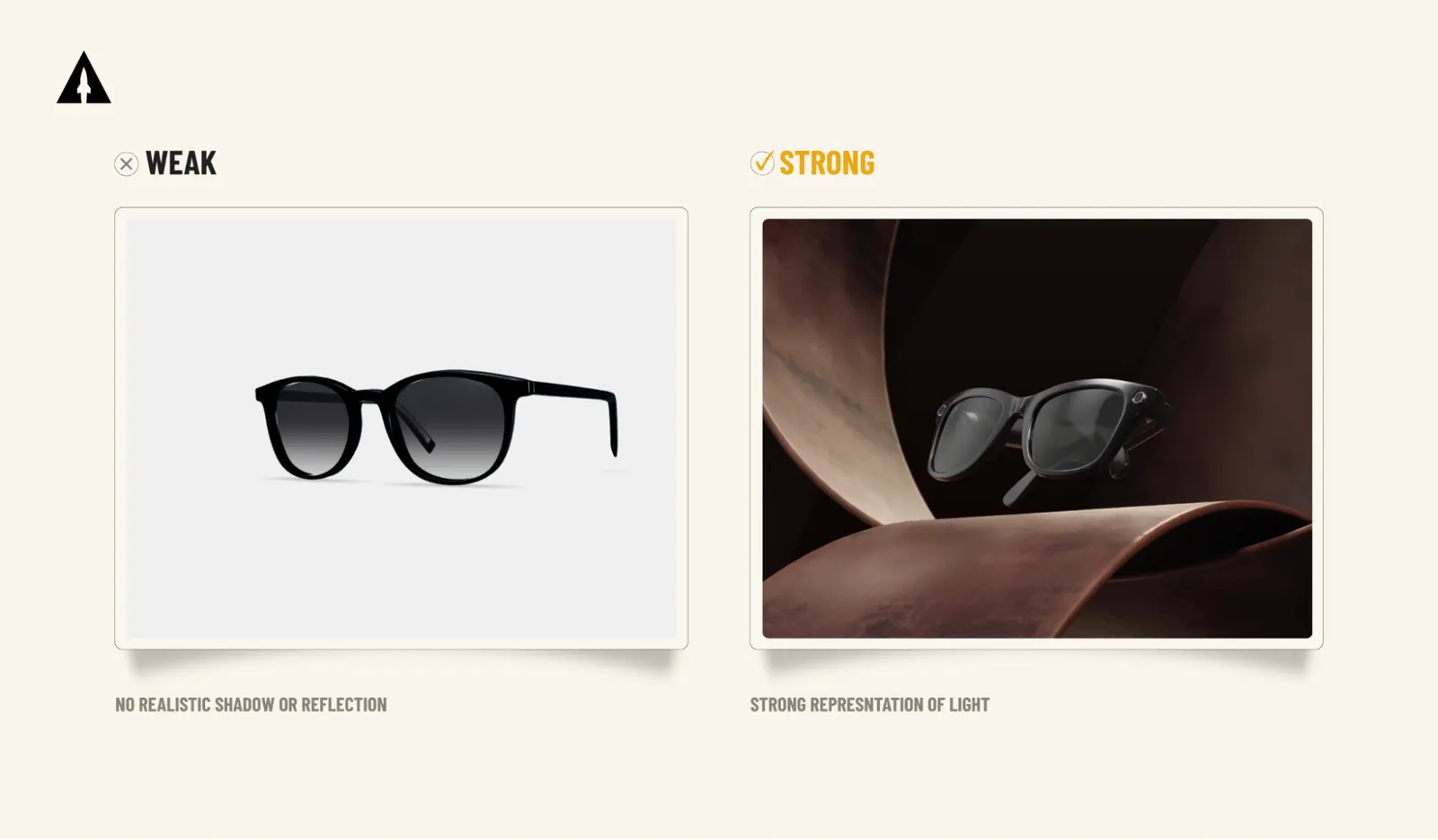
Likewise with the material: on the weak render, it’s unclear what the sunglasses are even made of. It just reads as flat black something. Could be plastic, could be metal, it’s hard to say. With the strong render, the material is obvious at a glance, and because the lighting and material are doing their job, the texture shows up too. The weaker render just looks like one flat, one-dimensional surface all the way through.
The stronger render is the one that performs better in marketing, and proves that collaborating with the right 3D artist is worth it over time.
Even if you have no prior experience hiring a 3D artist, there are ways to ensure you’re confidently making the right choice for your campaign. Always ask for extensive portfolio samples and then look closely at lighting, materials, and texture quality before you choose an artist who can get the job done.
Renders Without a Narrative
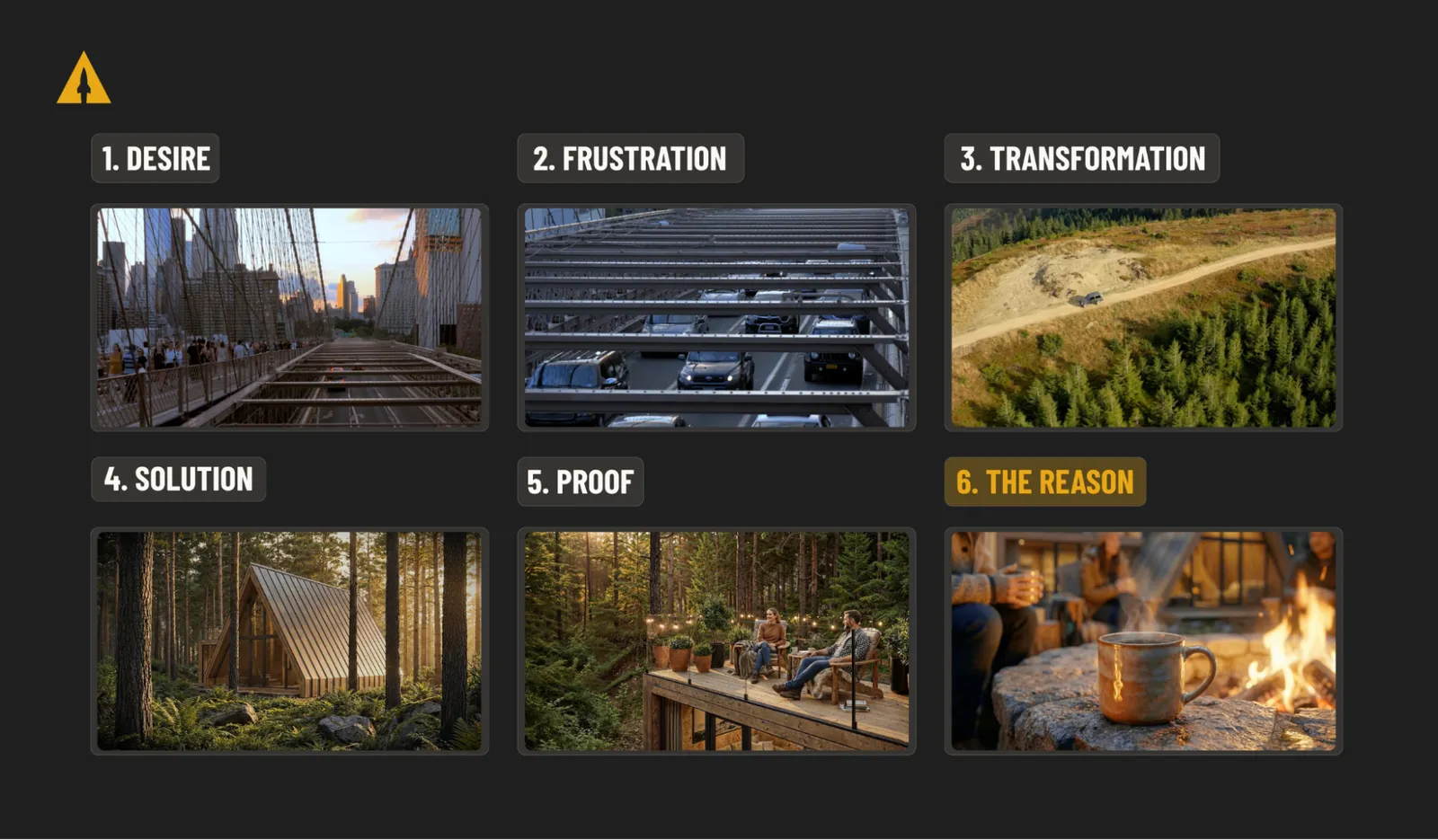
Most creators plan renders shot by shot: a hero shot here, a lifestyle shot there, an exploded view somewhere else. Gianluca says that’s backwards. Much like your campaign video and the rest of your ad creative, each render should serve a larger narrative built to turn a viewer into a customer. He walked through a six-beat framework using a real render set IAS produced for a boutique A-frame cabin in the woods.
-
The problem or desire. Don’t show the product yet, show the longing. For a remote cabin, that’s a packed city bridge full of commuters. That’s the life the customer wants to escape.
-
The current frustration. Same city, now bumper to bumper in traffic. The daily grind the customer is sick of.
-
The desired transformation. The same car, now on an open mountain road through the forest. Same vehicle, completely different life.
-
The product solution. One mechanism, one outcome, not a spec dump. Here it’s simply the cabin at golden hour, tucked in the trees. No square footage, no amenity list. Just the place you get to stay.
-
The proof or trust. A real couple on the deck, relaxed and happy. Real people in the space tell the customer this isn’t a fantasy, it’s somewhere they can actually go.
-
The reason to act now. A close-up of a steaming coffee mug by the fire as the light drops, with a call to action layered on top: “Now booking, first guests save 30%.”
The rule Gianluca uses is simple: if you can’t name which of those six beats a render is hitting, that render shouldn’t exist.
Going All-In on One Style
There are three ways to produce visual assets: CGI, real photography, and a hybrid of the two. The strongest campaigns use all three, but most founders lean on just one.
CGI is the workhorse. It’s how you do everything a camera physically can’t: exploded views, infinite zooms, a close-up on one tiny component, or the product in a location you’ll never actually visit. “With CGI you can do everything behind your desk. In real footage you can’t explode the product to show all the different components. That’s where CGI is most effective.”
Real photography fills narrower gaps: proof shots, behind-the-scenes footage, and lifestyle shots when the location is one you can actually shoot.
Hybrid is the heavy lifter. It’s for hero shots that need the trust of a real photo combined with the control of CGI, and for lifestyle scenes set somewhere filming isn’t realistic.
If the prototype isn’t camera-ready yet, CGI and hybrid carry nearly the entire asset library. In Gianluca’s words, “CGI and renderings can help convey the future vision of the project. We bring the vision to life before it even exists.” That’s the actual job a campaign is doing: selling something that doesn’t exist yet. CGI is how backers get to see it before it’s real.
Overproducing Too Early
It’s tempting to look at a successful campaign’s full render library and try to recreate all of it on day one, before there’s any data on what the audience actually responds to. Gianluca doesn’t recommend doing all that: “We don’t shoot the wedding before the proposal.” The better approach builds incrementally, based on data, and reuses everything along the way.
Start small for validation. A couple of strong hero renders and a 15- to 30-second product teaser is enough to test whether the concept resonates. If it doesn’t land, the budget hasn’t gone toward a full asset library that ends up shelved.
Build the full set once validated. This is where most of the render budget goes, because an effective pre-launch landing page needs how-it-works, benefits, lifestyle, comparison, and proof shots to help build a pre-launch email list on kickstarter. Skip these at pre-launch and the funnel underperforms.
Reuse for launch and beyond. The campaign page runs mostly on assets already produced, with a handful of new renders for specific moments. One catch: Kickstarter doesn’t allow photorealistic renderings on hardware and product design projects, so on those campaign pages, real photos of a working prototype have to carry the load. Post-launch adds real-life delivery and unboxing photography on top.
DIY-ing Too Much
So… how much of this can a founder just do themselves, especially with AI tools now in the mix? Not much, honestly. Rendering is a technical skill like any other, and it takes time to get good at it. Simply put, AI isn’t there yet.
That said, Gianluca still recommends founders use AI, just not as the final output. “What they can do is explore with AI. Today they have AI that can convey to professionals like me the exact things they would like to see for their product.”
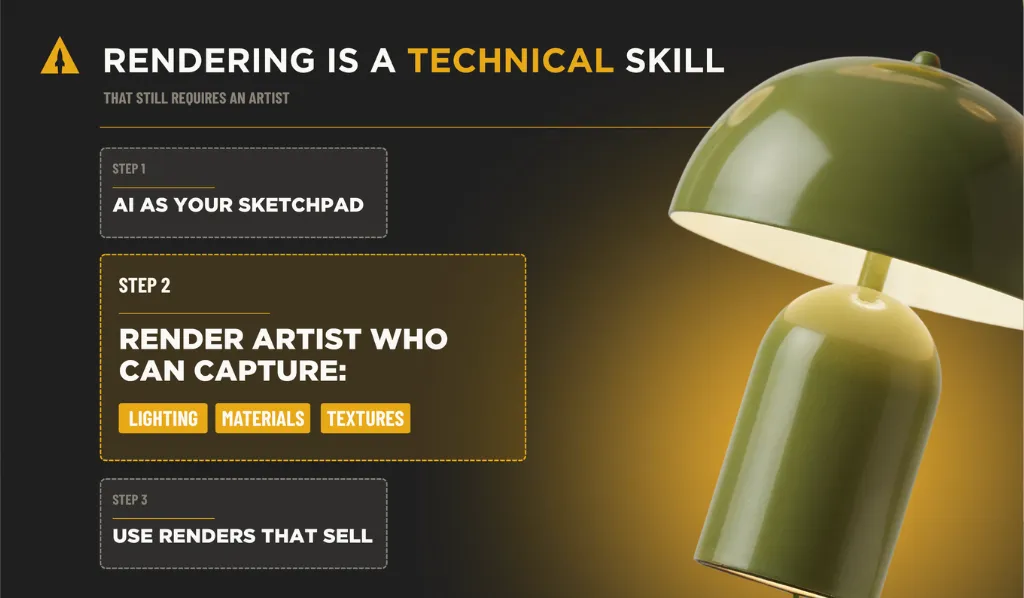
AI works as a sketchpad. A professional render artist is the delivery system. Use AI tools to clarify a vision and brief an artist clearly, rather than trying to skip the artist altogether.
If your renders are only checking one or two of these boxes, that’s worth a second look before your next launch. And if you want a hand thinking through your full pre-launch and campaign strategy, not just the visuals, LaunchBoom’s team can walk you through it.
3D Renders for Crowdfunding Campaigns: Frequently Asked Questions
Why are 3D product renders important for crowdfunding campaigns?
3D renders help backers visualize a product before it exists, making them especially valuable for crowdfunding campaigns. Strong renders can communicate the product’s design, materials, functionality, benefits, and future vision in ways that prototypes or photography may not be able to.
What makes a 3D product render look realistic?
Lighting, materials, and textures are the biggest factors. Together, they account for much of what makes a render feel realistic. Good lighting creates believable shadows and reflections, while accurate materials and textures help viewers understand what the product is made of and how its surface should look.
How do I choose the right 3D render artist?
Start by reviewing an artist’s portfolio closely. Look specifically at the quality of their lighting, materials, textures, and product realism rather than simply choosing based on how impressive the images look at first glance. An experienced artist should also be able to create renders that support your campaign’s marketing goals.
How many renders do I need for a crowdfunding campaign?
You don’t necessarily need a full render library from the beginning. Start with a few strong hero renders and a 15- to 30-second product teaser to validate whether the concept resonates with your audience. Once you have evidence that the product is working, build out additional renders for benefits, how-it-works explanations, lifestyle scenes, comparisons, and proof.
Should every render have a purpose?
Yes. Each render should contribute to the larger campaign narrative rather than simply showing the product from another angle. A useful framework is to connect renders to six beats: the problem or desire, the current frustration, the desired transformation, the product solution, proof or trust, and the reason to act now.
Should I use CGI, photography, or both?
Most campaigns benefit from a combination of all three. CGI is particularly useful for exploded views, detailed product demonstrations, and scenes that would be difficult or impossible to photograph. Real photography provides authentic proof and behind-the-scenes content, while hybrid imagery combines the credibility of photography with the flexibility of CGI.
Can CGI replace product photography?
Not completely. CGI is extremely useful when a product isn’t finished or when you need to visualize something that can’t easily be photographed. However, real photography can provide valuable proof that the product exists and help establish trust with potential backers. Using both gives campaigns more visual flexibility.
Can I create my own product renders with AI?
AI can be useful for exploring visual concepts and communicating your ideas to a professional artist, but it shouldn’t necessarily replace professional 3D rendering. High-quality product renders require technical knowledge of materials, lighting, modeling, composition, and realism. AI is best used as a creative sketchpad and briefing tool.
When should I invest in professional renders?
Ideally, validate the product concept before investing in a complete render library. A small set of strong visuals can help determine whether the concept resonates. Once the idea has traction, you can invest in the larger collection of renders needed for your pre-launch page, campaign page, advertising, and other marketing materials.
What should I show in my crowdfunding renders?
Your renders should communicate more than what the product looks like. Depending on the product, consider showing its key benefit, how it works, important components, use cases, lifestyle applications, comparisons, and proof points. The goal is to help potential backers understand both the product and why they should want it.
Can 3D renders help if my prototype isn’t finished?
Yes. One of the biggest advantages of CGI is that it can visualize a product before it is fully production-ready. This allows crowdfunding creators to communicate the intended final product and demonstrate features that may not yet be possible to show through photography.
Should I create all my campaign renders before launch?
Not necessarily. Producing every possible asset before validating your concept can lead to wasted time and budget. A more efficient approach is to start with a small set of high-quality visuals, use them to test audience response, and expand the render library once you know what resonates.
How can I use renders after my crowdfunding campaign launches?
Campaign renders can often be reused throughout the entire marketing funnel. The same assets can support your pre-launch landing page, crowdfunding campaign, advertisements, social content, email marketing, and other promotional materials. Additional photography can then supplement the library once real products are available.
What is the biggest mistake founders make with product renders?
One of the biggest mistakes is treating renders as individual images instead of parts of a marketing story. A technically impressive render can still be ineffective if it doesn’t communicate a meaningful benefit or move the viewer closer to becoming a backer. Every render should have a clear purpose within the campaign narrative.
How can I make my crowdfunding renders more effective?
Focus on five areas: prioritize realistic lighting, materials, and textures; give every render a role in your campaign narrative; combine CGI with photography where appropriate; validate your concept before producing a large asset library; and use AI to explore ideas and communicate with professional artists rather than relying on AI-generated images as the final product.
