


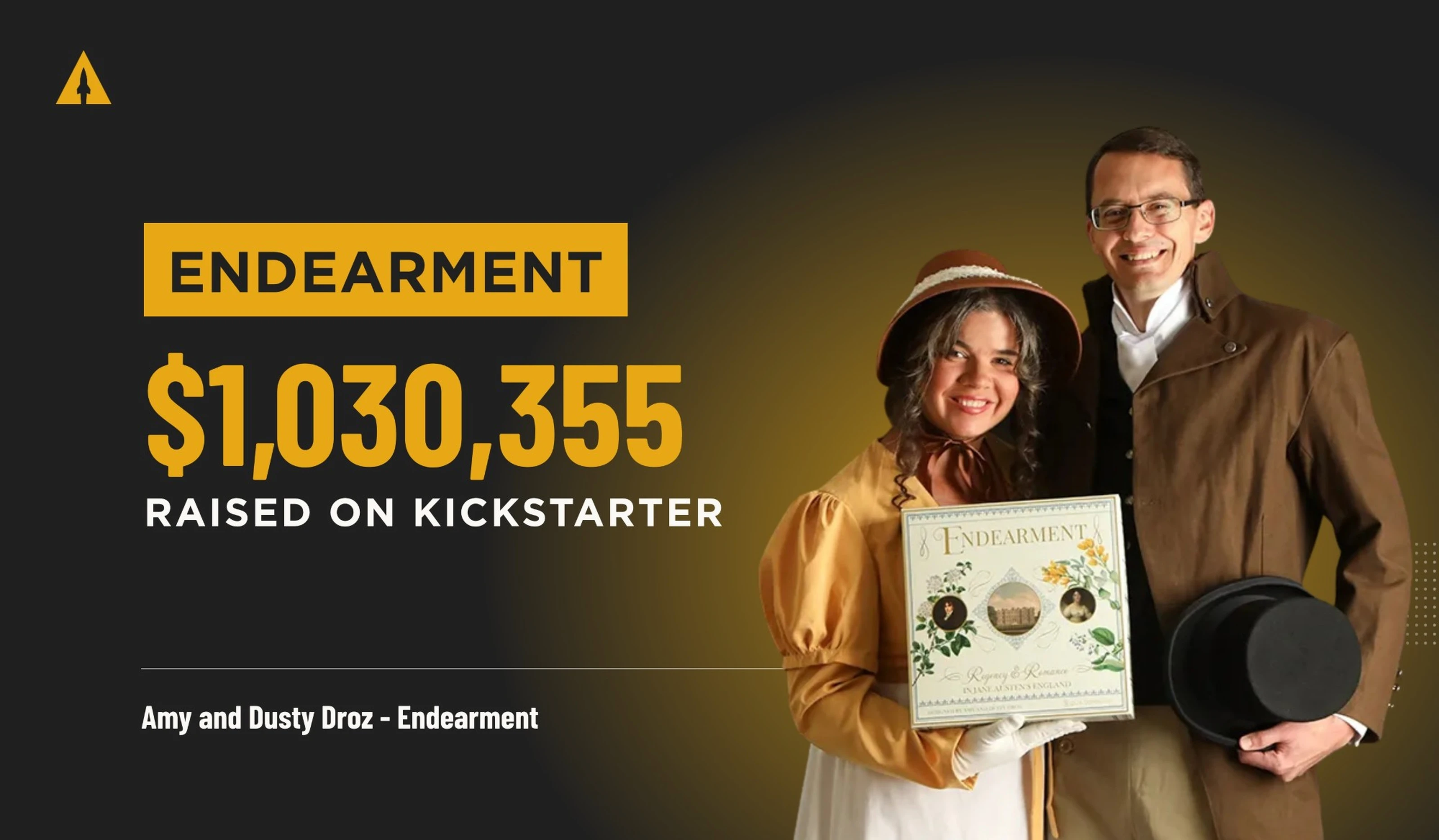
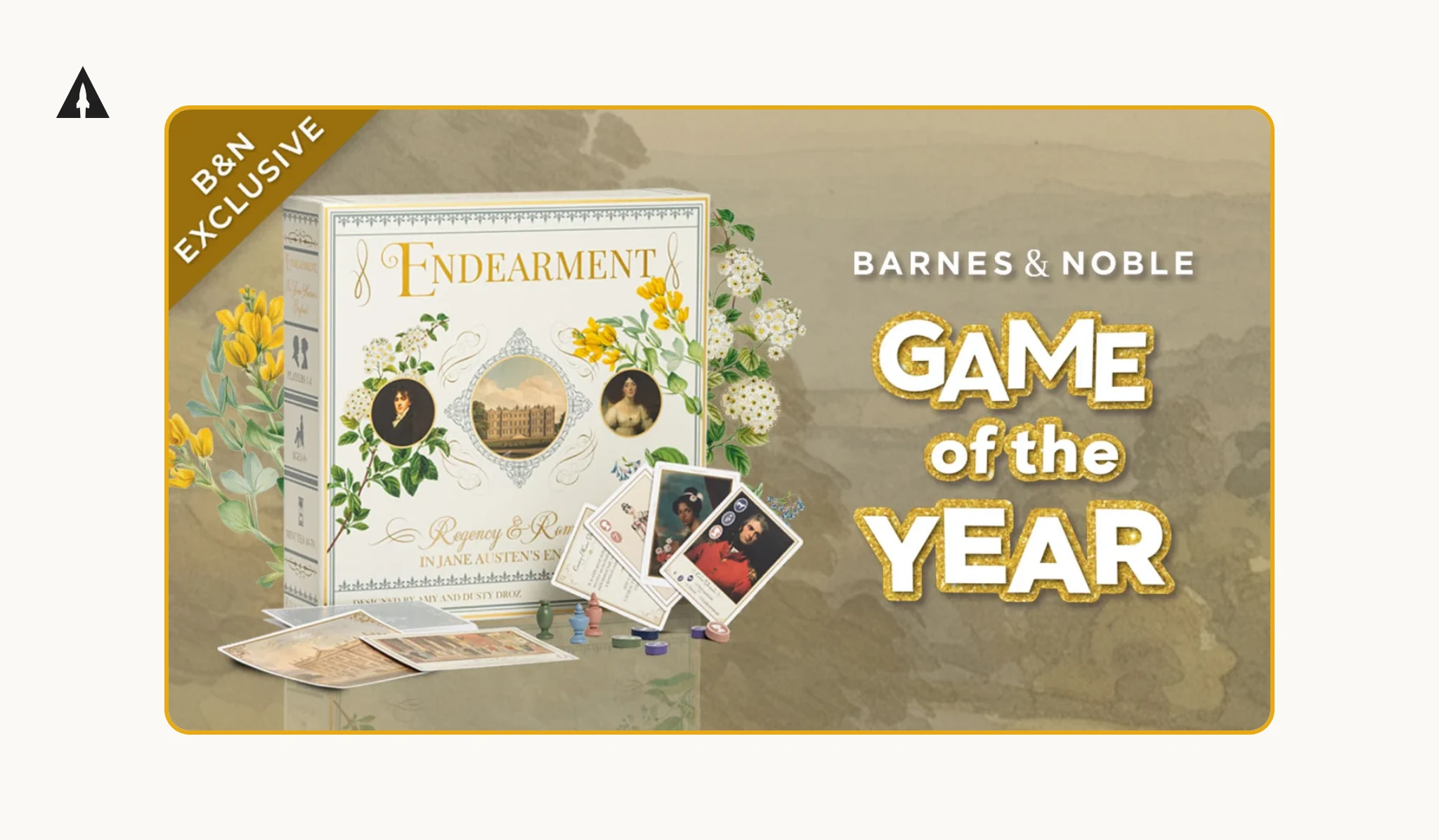
One Tuesday night, Amy and Dusty Droz got an email asking if they could get a copy of their board game Endearment to New York by Thursday morning. Knowing the potential behind the request, they made it happen. And that game just became Barnes & Noble’s Game of the Year.
Their company, Dux Somnium Games, is no stranger to success. We helped them launch their first Kickstarter in 2023, raising $1,057,307 for their game BOTANY. Since then we’ve launched six more games together, raised millions more, and watched as their small team built a highly profitable board game empire.
I could go on about their business success, but in this case study, we’re focusing on Endearment and the story behind getting Barnes & Noble Game of the Year. This was my fourth time sitting down with them and as usual, they shared knowledge bomb after knowledge bomb. Enjoy!
If you’d rather listen, here’s my chat with Amy on our podcast, Masters of Crowdfunding:
Key Takeaways
- Generate demand, then capture it: Ads and prelaunch campaigns create interest, and being on every channel where a buyer might look turns that interest into sales.
- Raise order value without raising prices: Instead of charging more, they added accessories backers actually want, like easels, liquid-core dice and dice trays.
- Test something new every campaign: Ad platforms keep changing, so they keep what works, drop what doesn’t and try something new each time.
- Build a system for anything that repeats: Any task that takes more than five or ten minutes a month gets a system, which lets a tiny team run a big catalog.
- Let the idea run free first: Amy creates without worrying about components, and only then do they shape the idea into a product that makes sense to build.
From Wedding Photographers to Game of the Year
Amy and Dusty have been together since they were 14. Before games, they were wedding photographers. Dusty says the pattern has been the same the whole time: Amy creates, and he builds a business around it.
Botany was their first game in Barnes & Noble. When they first got the news, they were at a convention. They high-fived, went up to the hotel restaurant for a slice of cake each, high-fived again, then went back to work. Every game they’ve made since has been placed at Barnes & Noble, but none of them have won Game of the Year.
So what’s it like to go from shooting weddings to Game of the Year? In their words: “It’s pretty surreal.”
Where Endearment Came From
Most game designers start with a mechanic and find a theme later. Dux Somnium Games works the other way around.
Their games start with Amy’s interests. She spends her mornings in the garden, thinking through ideas while she waters, then comes inside and unloads a pile of new ones on Dusty. At night she buys antique props on eBay. Old greeting cards, paint palettes, catalogs. She also keeps folders full of art she’s collected.
Ideas sit like that for months. Then one suddenly comes together, and it usually takes two weeks to go from a vague idea to a game that’s ready for playtesters.
Endearment followed that pattern. Amy told Dusty she wanted dresses in the game, and flowers too. Dusty pointed out they didn’t have a mechanic that supported dresses. Her answer was that they should figure that out.
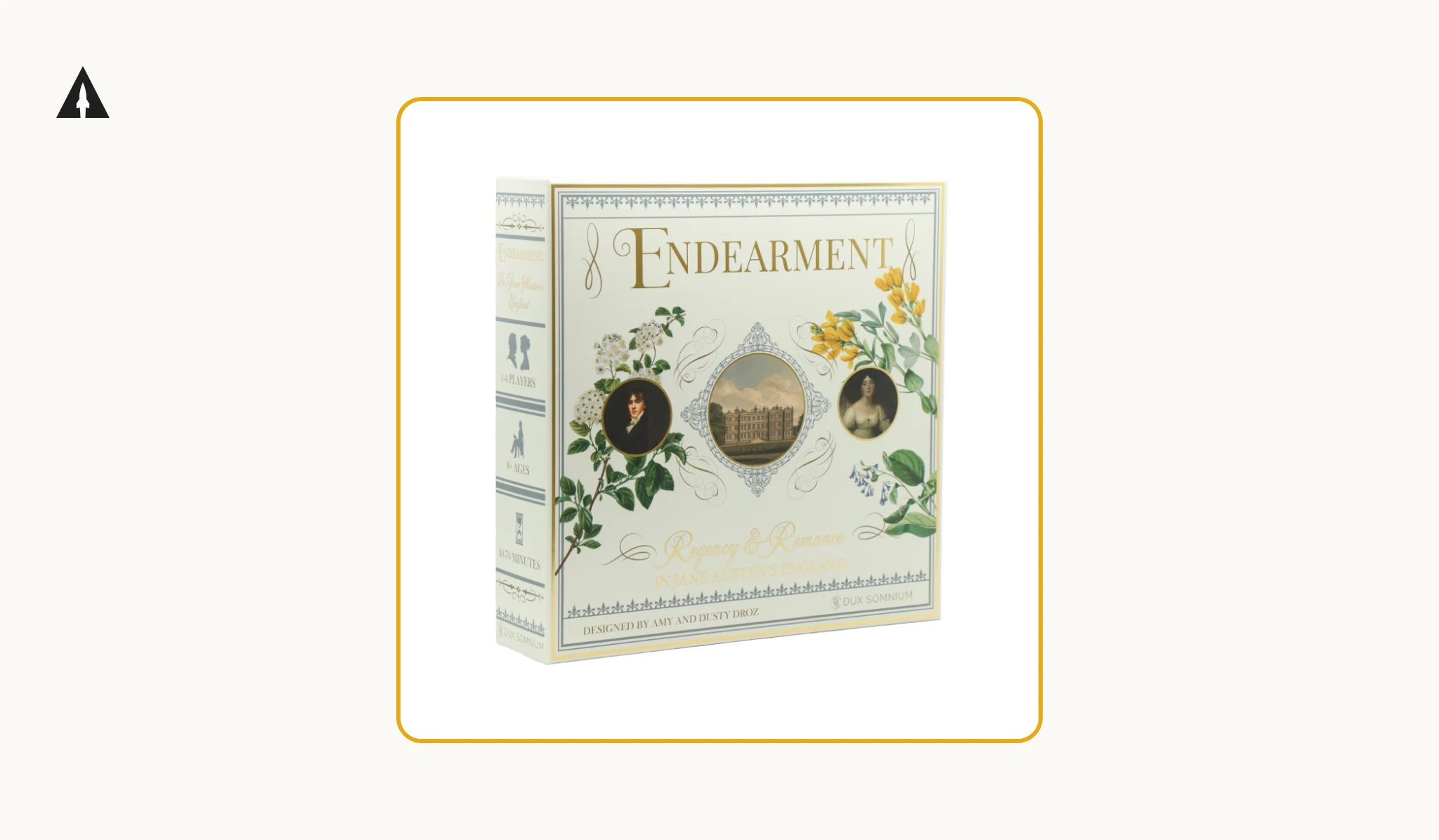
Amy also starts with the box. As she put it:
“I usually like playing with the different things and seeing, so whenever we are designing a game, I design the box almost first.”
From there, the box shapes everything else.
Dusty’s job early on is to stay out of the way. When Amy starts thinking about what would work for components too soon, he stops her: “What do you want? Don’t tell me, don’t think anything about components.”
He sees the business as his part of the work: it takes what Amy creates and runs with it. As he put it, “the creation just has to be let to do its thing.”
This reminds me a lot of writing or making a film. You start with way more than you need, and then you edit down. If you put too many constraints in at the top, you limit yourself. Once Amy knows what she wants, they start working out how to turn it into a viable product.
A Tiny Team With a Big Catalog
Here’s the part I think most founders should pay attention to. Dux Somnium Games is still a very small company.
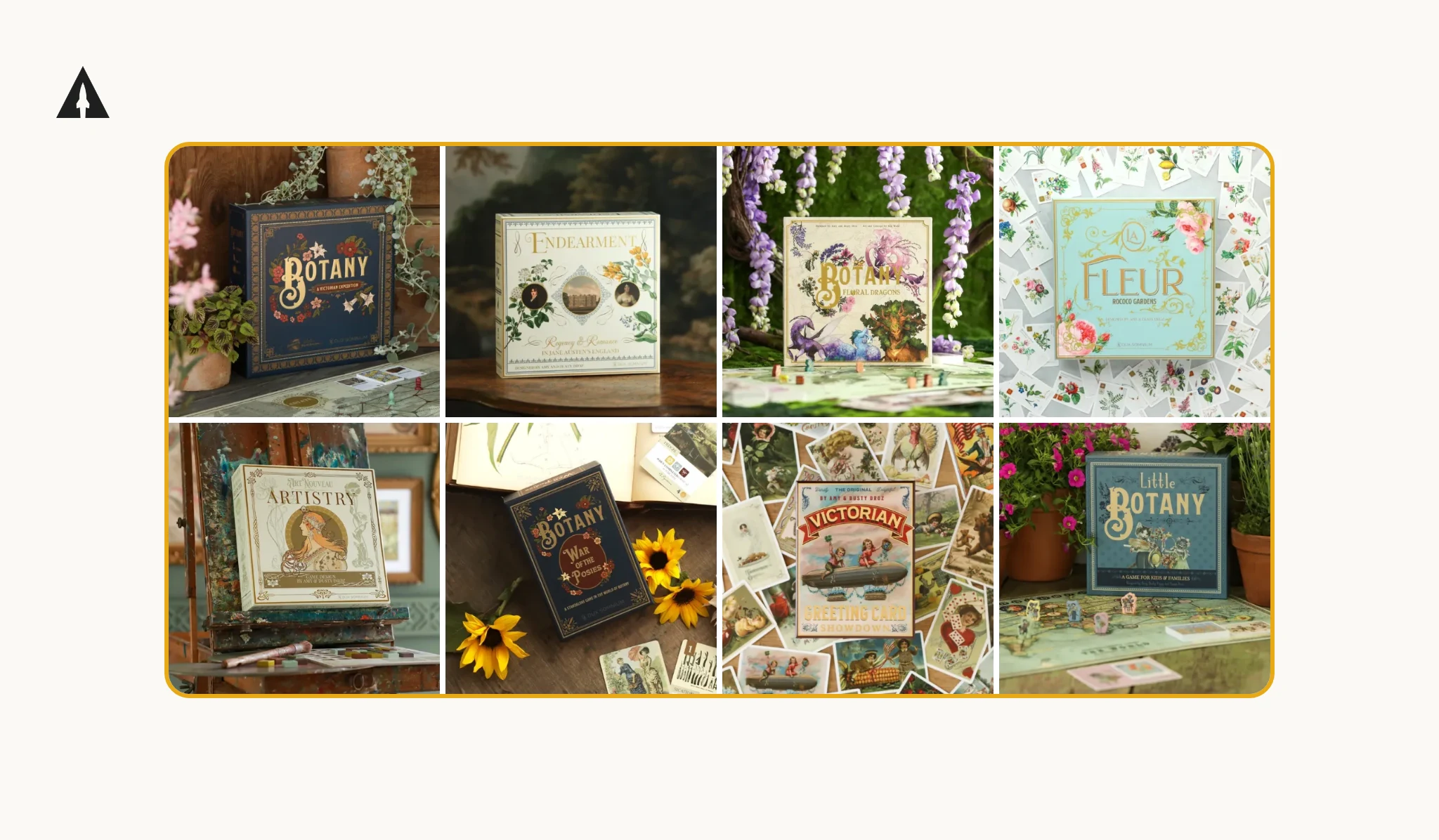
It’s Amy and Dusty, one part-time employee, and a group of contractors that hasn’t changed much in a year. Yet the catalog keeps growing. When Endearment launched, they only had a few products. By this Christmas, they plan to have 15 mainline games, plus a long list of accessories and expansions to go with them.
They’ve set up the business to handle tariffs, shortages and the highest shipping costs they’ve ever paid, and their prices have stayed steady through all of it. Advertising is the part that keeps changing. Meta has cut back on interest-based audiences because it wants advertisers on Advantage+, so what worked on one campaign may not work on the next.
A System for Everything
Dusty calls his side of the work business engineering. Amy’s side is creating.
Dusty spelled out the rule: “Anything that takes us more than five or ten minutes a month, we build out a system for it.” A lot of the time, he codes the system himself.
They also hired Jenny, their part-time employee, to handle player support and wholesale. That freed Amy up completely. “And because of that now Amy just spends all day creating,” Dusty told me. She makes the games, and she makes the creative for their ads too.
Generating Demand Before Launch
Dusty thinks about sales in three numbers for every channel: contact rate, conversion rate and average transaction value. How many people you can reach, how many of them buy, and how much they spend when they do.
That splits the work into two jobs.
The first is demand generation. For Dux Somnium Games, that means running ads and running their prelaunch campaigns through LaunchBoom. This is the part where you build interest before launch day, so the people who want your game are already waiting when you go live.
For Endearment, the prelaunch ran for about two months before the September 2 launch. The ads cost $12,587 and built a list of 10,798 people, about $1.17 a signup. Of those, 2,746 paid a deposit to reserve the game, about one in four. When the campaign went live, 1,608 of those reservers backed it, together pledging $193,559.
| Prelaunch metric | Endearment |
|---|---|
| Prelaunch ad cost | $12,587 |
| Leads (email signups) | 10,798 |
| Cost per lead (CPL) | $1.17 |
| $1 reservations | 2,746 |
| Cost per reservation (CPR) | $4.58 |
| Revenue from the prelaunch list | $240,094 |
| Prelaunch ROAS (list revenue ÷ prelaunch ad cost) | 19.1x |
The second is demand capture. That means being on every channel where a buyer might look, so the interest you create actually turns into sales. Dusty described what it looks like when you get this wrong:
“And if there’s ever a game you’re looking for and you go to Amazon and it’s not there and you go to other places and it’s not there and then you go to eBay and it’s being sold second hand, that’s a failure on demand capture, right?”
Testing something new on every campaign
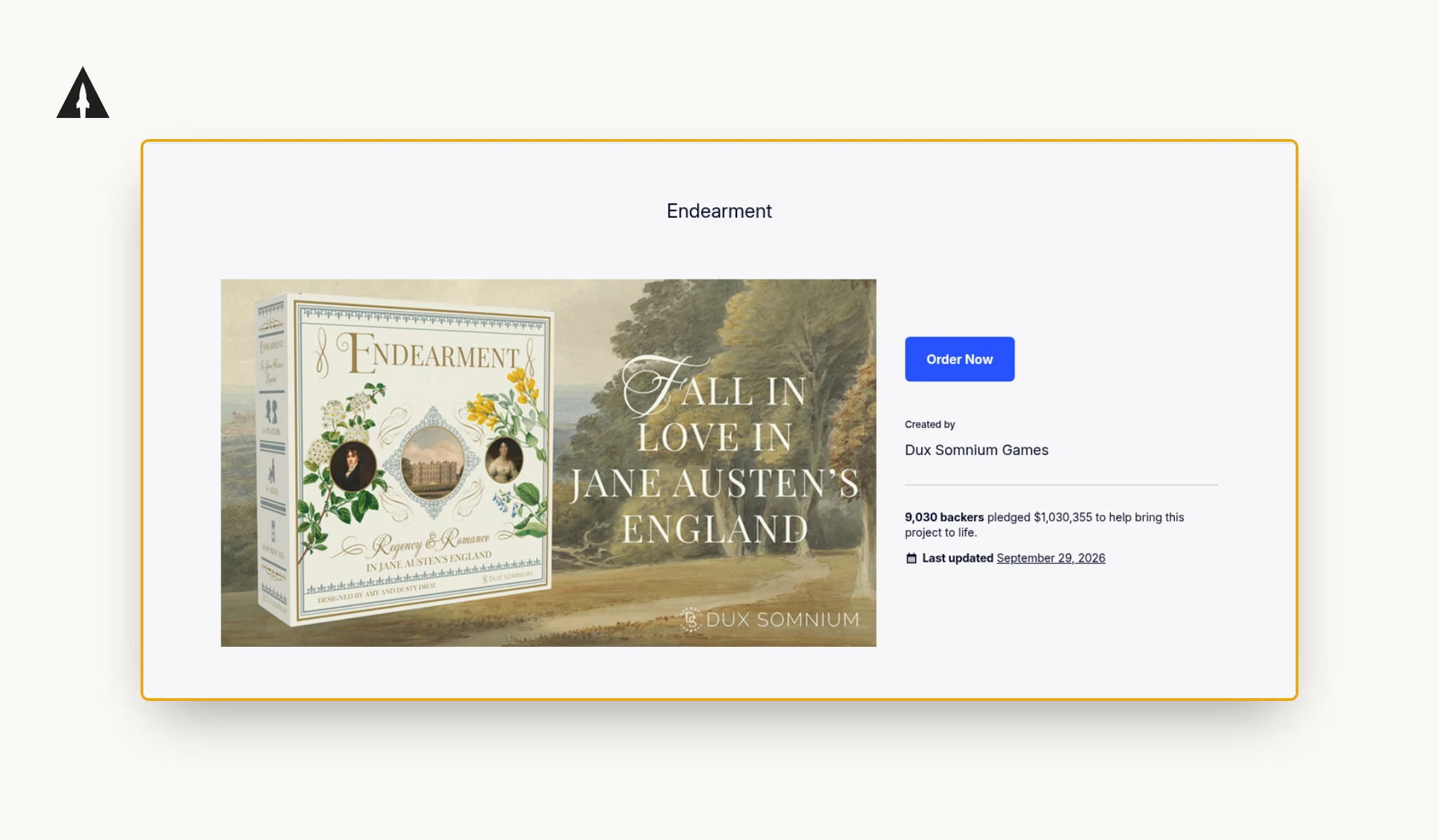
Endearment ran on Kickstarter from September 2 to October 2, 2025. Like every launch they’ve done, it wasn’t a copy of the one before.
Because ads keep changing, Amy and Dusty treat every campaign as a test. They keep what works and scale it. Then they cut what doesn’t. Here’s how they described that second half:
“What did we used to do that doesn’t work? Okay, get rid of that. Test new stuff, try new things.”
I remember them talking about this last year too. Every campaign, they test something, learn from it, and carry it into the next one. As they put it, “every single campaign we’ve had to do things slightly different than we did before.”
The Results
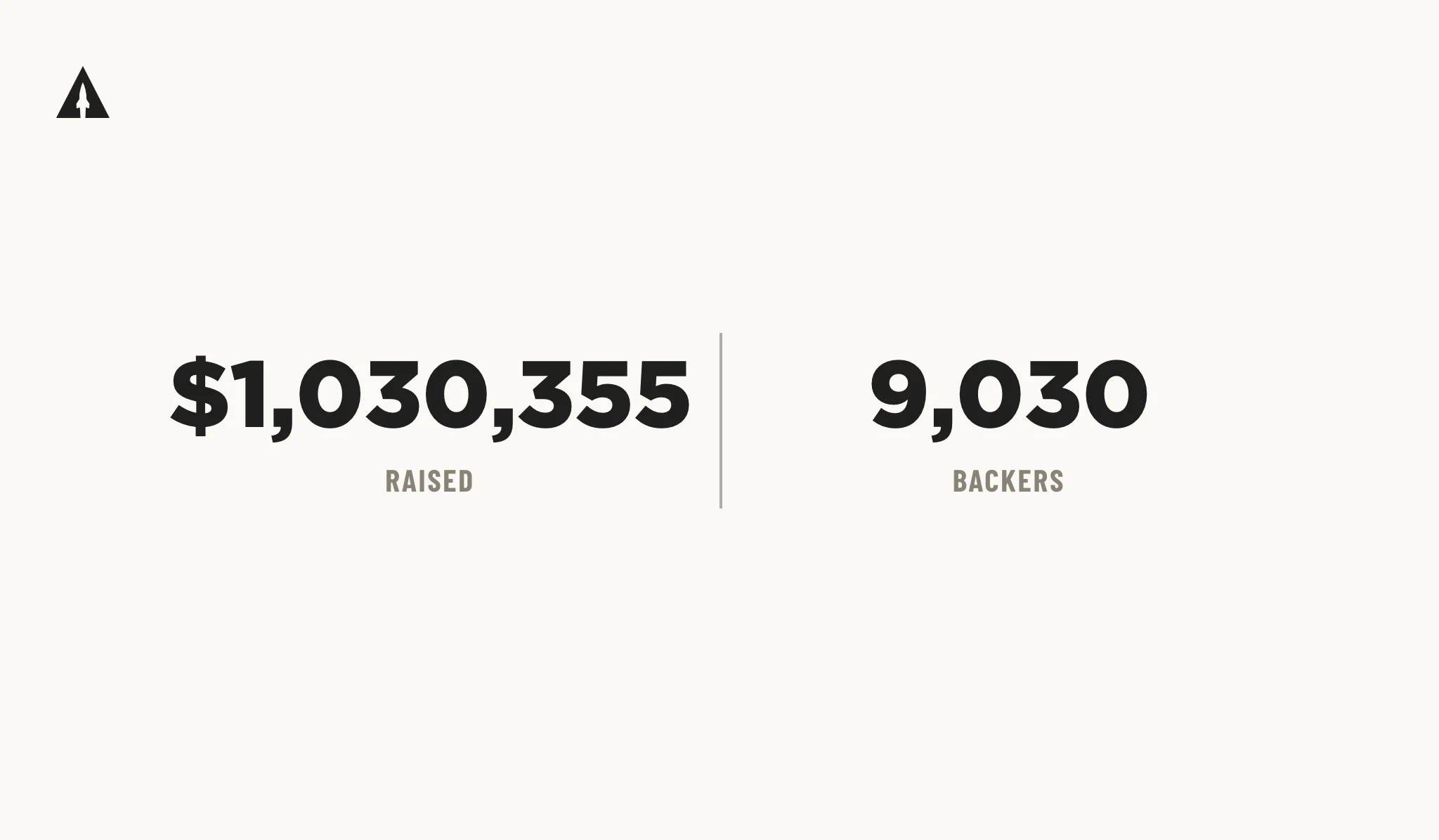
The Endearment Kickstarter raised $1,030,355 from 9,030 backers.
The timing mattered too. They ran the campaign in September and delivered it the following March, which turned out to be just right. Barnes & Noble only considers games for Game of the Year that are new and have just landed. Endearment arrived right inside that window. In Amy and Dusty’s words:
“And so we just happened to run the Kickstarter last September and we were delivering the Kickstarter this March.”
Their part of the process was small. They made a presentation about the game, how it plays, and who plays it. Then came the shipping scramble:
“So we live out in the boondocks. We got an email Tuesday night saying, can you get the game there by Thursday morning?”
FedEx said no. USPS said no. UPS said yes, and the game was in New York the next morning. The rest was Barnes & Noble’s own internal process (they think it involved a panel and judging). They asked if they could be in the room. They could not.
And Endearment won.
Ready for the spike
Being Game of the Year brings a lot of foot traffic, with front of store placements and special spots on seasonal tables. That’s very different from sitting in the game section. “The contact rate for this will just be huge,” Dusty said.
My guess is the award shows up in more than store sales. Plenty of people will see Endearment on a Barnes & Noble shelf, then go home and buy it online.
That’s exactly why they spent the run-up on demand capture. Knowing the award was coming, they made sure they were positioned correctly on Amazon and checked that Walmart.com, TikTok Shop and Shopify were set up and running (Walmart and TikTok Shop were still in process when we talked). They’re also expanding their online store into the UK and EU.
Endearment also reaches buyers they never planned for. It’s sold at the Jane Austen centers in London and Bath, and a fan on vacation sent them pictures of it in the gift shop. Someone else sent a photo of one of their games on a store shelf way up north in Canada, and they have no idea how it got there.
What’s Next: Raising Order Value Without Raising Prices
Their seventh Kickstarter, Reverie, was live when we talked. The new test this time was a bigger mix of accessories.
A lot of founders try to raise average order value by raising prices. Dux Somnium Games didn’t. Their pricing has stayed steady through tariffs and shipping costs, so instead they looked for things backers would genuinely want to add. Little easels for character cards. Dice with liquid cores. Dice trays.
Amy and Dusty said the dice trays stood out:
“Dice trays to go with the game, those are selling phenomenally well.”
All of those accessories have low minimum quantities, so the risk stays small. They also said they’re glad they waited until their seventh campaign to carry this much product, because they kept learning and refining the business along the way.
They keep adding new ways in, too. Kids’ versions of their games, puzzles for Endearment and others, and smaller card games at lower price points. The puzzles turned into a real side business. Some people buy only the puzzles and then come over to the games, and some go the other way.
Amy and Dusty’s Advice for Founders
Grow the audience instead of picking one
Most founders think they have two options: make more for the audience they have, or go chase a completely new one. Amy and Dusty think that’s the wrong question.
“I think a lot of people focus too hard on how do I make something for my existing audience or how do I go get this completely different audience?”
They try to do both at once. New entry points bring new people in, and the rest of the catalog serves them once they’re there.
Create first, then add constraints
Let the idea grow before you shut it down. Just don’t skip the second half. Dusty was clear about that:
“We should think about components, like anybody listening to this, think about components.”
The Takeaway
Amy and Dusty started as wedding photographers. Their Endearment Kickstarter raised $1,030,355 from 9,030 backers and went on to become Barnes & Noble Game of the Year.
Three things got them there: a small team with a system for everything, ads and prelaunch campaigns that generate demand, and a plan to capture that demand wherever buyers look. And more importantly, they test something new every single time, because the playbook that worked last campaign won’t stay the playbook forever.
If you’re a founder with a game you believe in and you want to build that kind of demand before launch day, book a call with a LaunchBoom strategist and we’ll talk through your project.
