



You’ve done the hard part, you built a game people actually want to play, and a community that can’t wait to back it. But now comes the part that separates dreamers from publishers: turning that prototype into a real, physical product that can sit on someone’s shelf.
This is where digital files become wood tokens, linen cards, and printed rulebooks. It’s where you’ll meet your manufacturer, talk about timelines and specs, and make a hundred small decisions that all affect your cost, your quality, and your sanity.
Even the best-designed game can fall apart if it’s poorly manufactured. A bad batch of components, a delayed shipment, or a misunderstanding in materials can sink your campaign’s profit margins before you even ship the first box.
So we’re breaking down everything you need to know to get your board game manufactured right the first time: from choosing the right partner, to managing quotes and proofs, to keeping your production on schedule.
KEY TAKEAWAYS
- Timing matters: Work with board game manufacturers only after your mechanics and art are completely finalized to avoid costly revisions
- Cost varies widely: Your per-unit cost depends on materials, order quantity, and component complexity. You can expect $6.50–$12 per unit for most indie games
- Quality control is your job: Even great manufacturers make mistakes, so review every proof carefully before approving mass production
- Plan for the long haul: From proofing to delivery, expect 3–6 months minimum, with built-in buffers for delays
- The right partner matters: Experienced manufacturers who understand crowdfunding can save you thousands in mistakes and missed deadlines
Prefer to learn in video form? I got you. Check out the video version of this post below:
What Do Board Game Manufacturers Actually Do?
Board game manufacturers are the bridge between your digital files and physical products. They take your finalized artwork, component specifications, and packaging designs and transform them into tangible games that backers can hold, play, and share.
But their role goes way beyond just printing cards and assembling boxes. Experienced board game manufacturers manage complex timelines across multiple production lines, source and quality-check materials from various suppliers, coordinate with freight companies and fulfillment centers, and provide critical feedback on specifications that might cause problems down the line.
The manufacturer you choose directly impacts your game’s quality, your delivery performance, your production efficiency, and ultimately, your profitability. A great manufacturing partner will catch potential issues before they become expensive problems.
They’ll help you understand which component upgrades actually enhance gameplay versus which ones just inflate costs. And they’ll communicate clearly about realistic timelines so you can set accurate expectations with your backers.
A Step-by-Step Breakdown of the Board Game Production Process
Understanding the board game production process helps you anticipate challenges, communicate better with your manufacturer, and avoid costly mistakes. Let’s walk through each stage of the journey from finalized files to delivered games.
1. Finalize Game Design and Artwork
You want to work with a manufacturer when your game mechanics and art are all finalized. You’ve playtested all the rules, you’re satisfied with the design, and you don’t anticipate any more changes happening. Having those things in order first helps you avoid costs later.
Every change you make after submitting files to your manufacturer creates delays and potentially additional charges. Lock in your card counts, board layouts, token quantities, and rulebook text before moving forward. Your manufacturer can’t help you if the foundation keeps shifting.
If you still think you might be at the pre-manufacturing stage, check out this blog post on Creating Renders for Your Board Game.
2. Choose the Right Manufacturer
When choosing a board game manufacturer, you need to look beyond just the lowest quote. The board game manufacturing world is small, but there are clear leaders who consistently deliver high-quality products on budget and on time.
Strong, clear communication and a responsive sales team matter more than you might think. You want a manufacturer with a track record with other crowdfunded titles, who understands the unique pressures of Kickstarter delivery dates and backer expectations.
They should be willing to send pre-production samples (PPCs) and white box proofs without pushback. And they should provide clear quoting that includes options for stretch goals, inserts, and packaging upgrades.
Always request samples of similar components before committing. Ask other creators about their experience, many are happy to share privately what worked and what didn’t.
3. Build a Complete Specification Package
Before production begins, you need to lock in your specifications. This includes your complete component list: cards, boards, tokens, player mats, rulebooks, inserts, boxes, and any other pieces. Confirm final sizes for every element. You’ll go over things like card dimensions, token sizes, and box dimensions.
It’s important to choose your materials and finishes carefully. Will you use paper, chipboard, wood, or plastic for different components? What about UV spot gloss, foil stamping, or embossing? Each choice affects cost, appeal, and player experience.
Make sure your packaging design is final and proofed. Your box art, dielines, and rules need to be locked before manufacturing begins.
Use a “bill of materials” (BOM) to keep everything organized. Your manufacturer will use this document to quote pricing and timelines. The clearer your BOM, the more accurate your quote.
Overdesigning your game with too many custom components can balloon costs and increase delays. Prioritize components that enhance gameplay, not just components that look impressive in photos.
4. Get a Manufacturing Quote and Proofs
Once you submit your specifications, you’ll receive a quote from your manufacturer. This typically includes tooling costs (one-time fees for custom molds or dies), per-unit costs based on your order quantity, and sometimes setup fees for specific processes.
After you approve the quote, the proofing stage begins. First comes digital proofing, which takes about 1-2 weeks. You’ll receive PDF proofs of every component: cards, boards, rulebooks, box art.
Review these carefully. Check colors, text alignment, bleed areas, and make sure nothing got lost in translation.
Next comes pre-production samples, which take 2-3 weeks. These are physical samples using your final materials. You might receive a “white box” sample (components in a plain box) or a PPC (pre-production copy) that includes everything exactly as it will appear in the final product.
This is your last chance to catch mistakes before mass production.
Hold the cards. Shuffle them. Check the board for warping. Make sure tokens fit in their designated spaces. Verify that the box closes properly with all components inside.
Don’t sign off on mass production until you’ve held a final sample in hand and checked it against your spec sheet.
5. Begin Mass Production
Once you approve the pre-production samples, mass production begins. This phase typically takes 6-10 weeks, depending on your game’s complexity and your manufacturer’s current workload.
During mass production, different components often run on different timelines. Cards might finish printing before plastic miniatures are ready. Boards might be done while boxes are still being assembled. Your manufacturer coordinates all these moving pieces to ensure everything comes together at the end.
Quality control runs happen throughout this phase. Manufacturers check color consistency, registration (alignment of printed layers), and component dimensions. They’ll often send production photos at key milestones, especially if you request them.
Machine setup takes just as much time and effort whether you’re printing 500 units or 50,000 units. That’s why manufacturers have minimum order quantities or MOQs. That’s because the setup cost needs to be distributed across enough units to make economic sense.
6. Freight, Fulfillment, and Delivery Preparation
After production completes, your games need to get from the factory to your backers. This freight and fulfillment phase can take anywhere from 4-12 weeks, depending on shipping method, destination, and current logistics conditions.
You’ll need to coordinate with logistics companies and factor in customs, import duties, and warehouse planning early. Your box size, component weight, and finishes all impact freight costs. A game that’s slightly oversized or unnecessarily heavy costs significantly more to ship across an ocean.
If you’re shipping internationally, you’ll need to understand VAT requirements, import duties, and labeling regulations, especially if selling in the EU or UK. These aren’t “later problems,” they affect your pricing, your timeline, and your legal compliance.
Many creators work with fulfillment centers that receive container shipments and then distribute to individual backers. Plan this relationship before your games leave the factory.
If you’re not sure where to start with fulfillment, you can check out our article on The 11 Best Fulfillment Crowdfunding Services Compared.
How Much Does It Cost to Manufacture a Board Game?
Understanding manufacturing costs helps you price your game correctly, set realistic funding goals, and protect your profit margins. Let’s break down the major cost categories you’ll encounter.
Tooling Costs
Tooling costs are the expenses associated with designing, developing, and fabricating the tools, molds, dies, and fixtures used in manufacturing processes. These are typically one-time fees that you pay regardless of how many units you produce.
Your tooling cost can range depending on how common or how unique your components are. Standard plastic circle tokens or acrylic gems might cost less because the manufacturer already has the molds on hand. Something completely custom, like a uniquely shaped miniature or a custom die, requires creating new molds, which can cost thousands of dollars. A standard token made out of punchboard might not run up a big bill, but a custom miniature with a steel mold could cost you over $5,000 base before you even produce a single unit.
Material Costs
Material costs are really where you see the most variance in pricing. Your choice of materials dramatically impacts both your budget and your game’s feel.
On the affordable end, you have punchboard components — the cardboard tokens and tiles you see in most standard games. These are cost-effective and work perfectly for many game types.
Mid-range options include premade plastic components and wooden pieces. These add a nice tactile quality without breaking the bank. More complicated plastics like acrylics with custom shapes or colors fall into mid-tier pricing.
At the higher end, you get into metal components and highly detailed custom miniatures. The types of board game materials you choose should align with your game’s needs and your target price point. A $30 family game doesn’t need metal coins, but a $120 deluxe edition might benefit from premium materials that justify the price.
Minimum Order Quantities and Bulk Pricing
The minimum order quantity for board games is the smallest number of units that a manufacturer will produce for mass production. Mass production machines like offset printers require significant setup.
Once the machines are running, production is very fast and very affordable, but it takes just as much time and effort to set up a print run for 500 units as it does for 5,000 or 50,000 units. That’s why most manufacturers have an MOQ, which is normally around 500–2,000 units. Below that threshold, the setup costs make production economically unfeasible for both you and the manufacturer.
The relationship between order quantity and board game component costs creates interesting pricing dynamics. Consider these real-world examples:
- 1,000 units at $12 each = $12,000 total
- 5,000 units at $6.50 each = $32,500 total
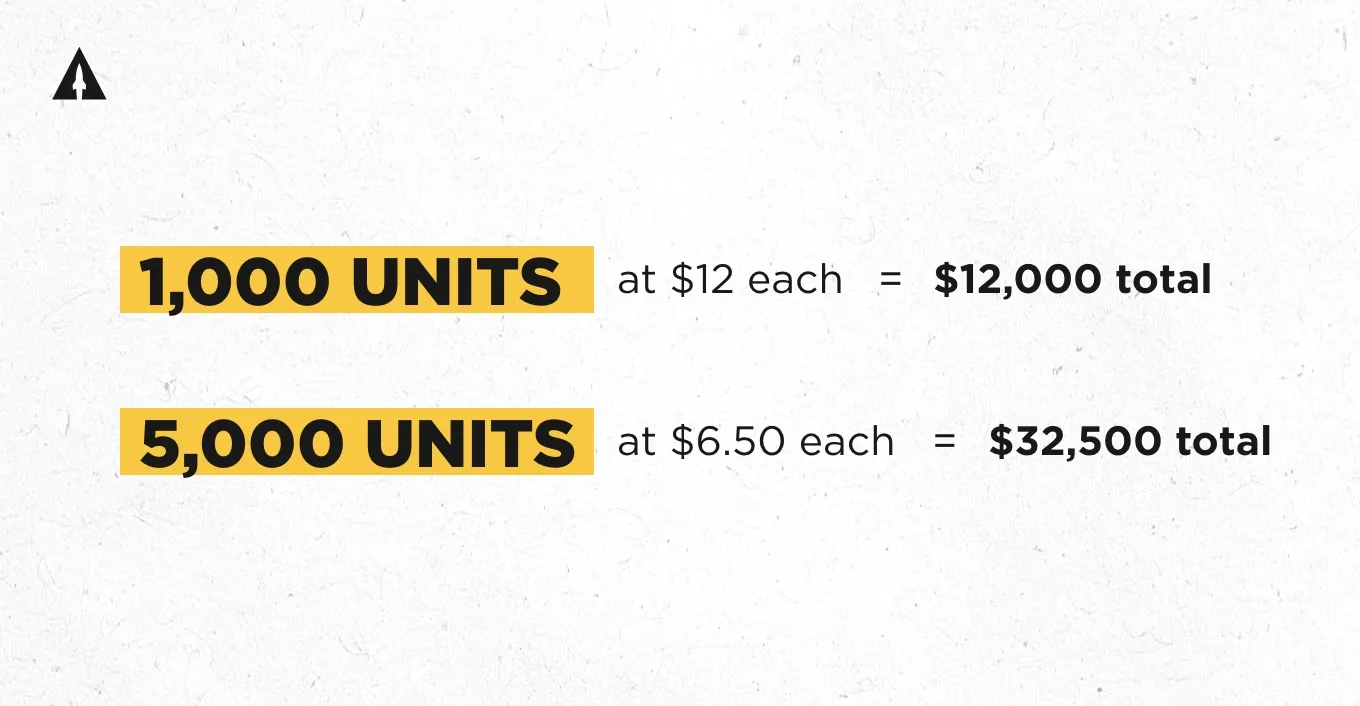
You’re paying nearly three times more total for the larger order, but your per-unit cost drops by almost half. This affects everything from your Kickstarter pricing to your retail strategy to your storage needs.
Add 10-15% buffer inventory for damaged or lost items and customer service replacements. If you’re ordering 1,000 units for 1,000 backers, you’re setting yourself up for problems when inevitable shipping damage occurs.
Per Unit Costs
Per-unit costs are calculated by taking your total production costs (tooling + materials + setup costs) and dividing by your order quantity. The more units you order, the lower your per-unit cost becomes, because the tooling costs get distributed across more games. Want to learn more about costs? Check out our full breakdown on How Much it Costs to Publish a Board Game.
How Long Does Board Game Manufacturing Take?
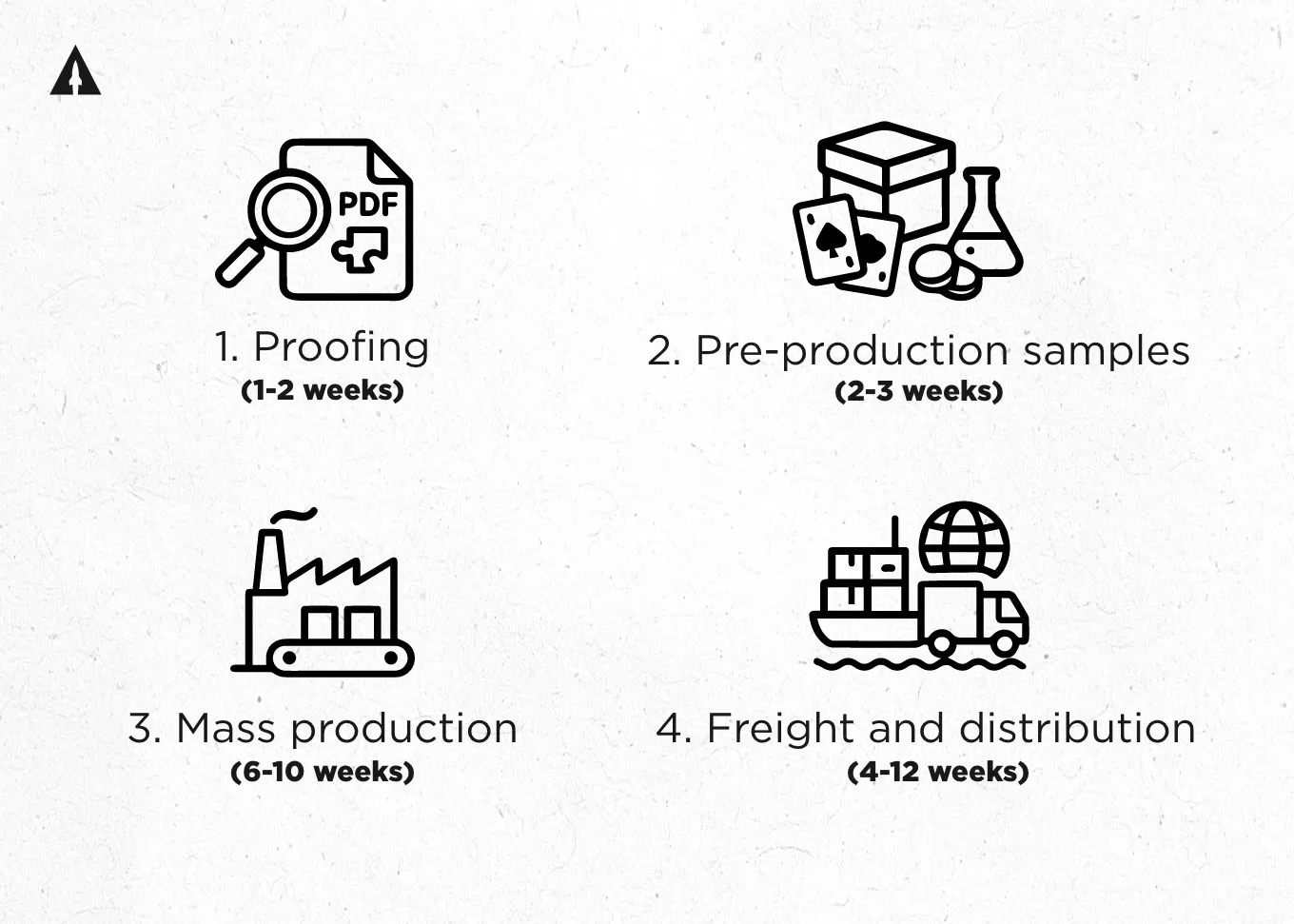
The game manufacturing timeline is longer than most first-time creators expect. From the moment you submit final files until games arrive at your fulfillment center, you’re looking at a minimum of 3–6 months. Let’s break down where that time goes.
Proofing (1-2 weeks): This is when you review digital PDFs of all your components. You’re checking colors, text, alignment, and making sure nothing got corrupted in file transfer. Rush this stage and you’ll catch mistakes in physical samples — or worse, in the final product.
Pre-production samples (2-3 weeks): Your manufacturer creates physical samples using your actual materials. This is when you see how colors really look, how cards actually feel, and whether everything fits in the box. International shipping adds time here if you’re not located near the factory.
Mass production (6-10 weeks): This is where the bulk of time goes. Different components run on different production lines with different timelines. Cards might finish before miniatures. Boards might be done while boxes are still being printed. Your manufacturer coordinates all these elements to come together at the end.
Freight and distribution (4-12 weeks): Ocean freight is cheaper but slower. Air freight is faster but expensive. Most indie creators use ocean freight, which means 4-8 weeks on the water, plus customs clearance, plus ground transportation to your fulfillment center.
Common delays can add weeks or months to this timeline. Lunar New Year shuts down Chinese manufacturing for 2-3 weeks every January or February. Port backlogs, especially at major US ports, can add weeks of waiting. Component shortages, particularly for specialized items, can delay your entire production run.
Build in padding for delays. If you promise backers delivery in October, your games need to leave the factory in July. Use project management tools like Trello or Notion to track dependencies, deadlines, and approvals across this complex timeline.
The Best Board Game Manufacturers for Indie Creators
Choosing from the best board game manufacturers can feel overwhelming when you’re launching your first game. These three companies have proven track records with crowdfunded creators and consistently deliver quality products.
Panda Game Manufacturing
Panda is known for high quality, design expertise, and deluxe components. They’re the manufacturer behind successful titles like Wingspan, a game that won awards partly because of its exceptional component quality.
What sets Panda apart is their willingness to provide design feedback during the quoting process. They’ll tell you if a component choice will cause problems or if there’s a more cost-effective way to achieve your vision. They offer full-service packaging solutions and have extensive experience with stretch goals and Kickstarter timelines.
Panda’s pricing tends to be higher than some competitors, but many creators find the quality and service worth the premium. They’re particularly strong with games that feature custom wooden components, detailed miniatures, and complex packaging.
LongPack Games
LongPack has become one of the most popular options for Kickstarter games, and for good reason. They’re known for strong communication and handling a wide variety of components with consistency.
Their sales team is responsive and experienced with crowdfunding timelines. They understand the unique pressures of backer expectations and delivery dates.
LongPack offers competitive pricing across a range of game complexities, from simple card games to elaborate productions with multiple component types. Many creators appreciate LongPack’s straightforward quoting process and their willingness to work with first-time publishers. They’re a solid choice if you want reliable quality without premium pricing.
Whatz Games
Whatz Games offers competitive pricing and has become a favorite for mid-budget campaigns. They’re particularly good for creators scaling up after a first campaign — you’ve learned the basics, and now you want a manufacturer who can handle moderate complexity without premium costs.
Whatz has good minimum order quantities that work for indie creators, and they’re trusted by creators who are growing their publishing businesses beyond a single title. Their quality is consistent, and their communication is professional. They’re a strong middle-ground option: better pricing than premium manufacturers, but more experienced with crowdfunding than generic factories.
Common Pitfalls and How to Maintain Board Game Quality Control
Manufacturing mistakes are expensive and time-consuming to fix. The creators who succeed are the ones who catch problems early and maintain rigorous standards throughout production.
Common Errors to Avoid
Finalizing files too early is one of the biggest mistakes new creators make. You’re excited to move forward, so you submit files before your rules are truly locked or before you’ve done enough playtesting with the actual components you plan to use. Every change after file submission costs time and money.
Unrealistic timelines sink campaigns. You promise backers delivery in six months, but you haven’t even finalized your manufacturer yet. Manufacturing alone takes 3-6 months, and that’s assuming everything goes perfectly. Build in buffer time for the inevitable delays.
Vague BOMs create confusion and inaccurate quotes. If your bill of materials says “tokens” without specifying size, material, thickness, and finish, your manufacturer has to guess. Those guesses often don’t match your vision, leading to expensive revisions.
Over-customization might look impressive in photos, but it leads to high costs and production headaches. Every custom component requires its own tooling, its own production timeline, and its own quality control process. Focus on the components that actually enhance gameplay.
Board Game Quality Control Checklist
Board game quality control is ultimately your responsibility, not your manufacturer’s. Even great manufacturers make mistakes, and it’s your job to catch them before thousands of units get produced incorrectly.
Inspect both PDF and physical proofs thoroughly. Don’t just glance at them; actually read the rulebook, check every card for typos, verify that colors match your expectations. Shuffle the cards to see if they feel right. Check if tokens fit in their designated spaces.
Ask for production photos at key milestones. Many manufacturers will send photos of the first units off each production line if you request them. This gives you visibility into the process and lets you catch issues before the entire run completes.
If possible, use an in-country quality control agent. For a few hundred dollars, you can hire someone in China to physically visit the factory and inspect your games before they ship. They check for color accuracy, component quality, packaging integrity, and whether everything matches your specifications.
Never approve a full print run until you’re satisfied with the pre-production sample. This is your last chance to make changes before thousands of units get manufactured. Take your time with this approval. Sleep on it. Show it to trusted playtesters. Make sure it’s right.
Learn from These Successful Production Examples

Looking at successful games helps you understand how manufacturing choices impact the final product and market reception. These examples show what creators did right and why it mattered.
Wingspan and Panda Game Manufacturing
Wingspan worked closely with Panda to ensure beautiful quality that matched the game’s elegant design. From the custom egg tokens that feel substantial in your hand to the embossed card trays that organize components perfectly, every manufacturing choice reinforced the game’s theme and quality.
Stonemaier Games didn’t just accept standard components. They collaborated with Panda to develop custom solutions that enhanced the player experience. The birdfeeder dice tower, the upgraded resource tokens, the textured cards. These weren’t arbitrary upgrades, they made the game more enjoyable to play and more attractive on the table.
That attention to manufacturing detail contributed to Wingspan’s critical and commercial success. Players felt the quality the moment they opened the box, which justified the price point and encouraged word-of-mouth recommendations.
PARKS and the Focus on Visual Storytelling
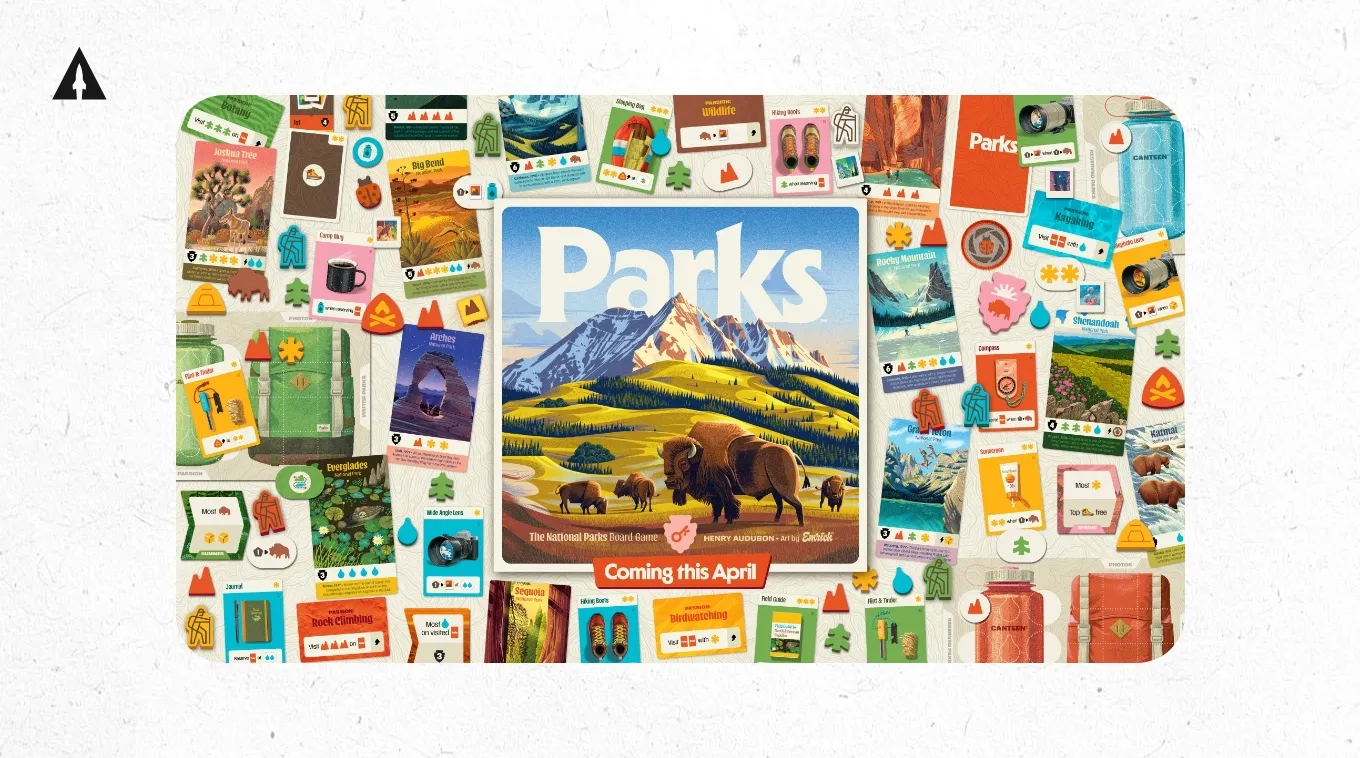
PARKS used custom wooden tokens and high-quality cards to reinforce the game’s focus on nature and conservation. The wooden hiker meeples, the metal first-hiker token, every component choice supported the visual storytelling.
The manufacturer helped translate the game’s stunning artwork into physical components that did justice to the original illustrations. The color matching was precise, the card stock was premium, and the box construction was sturdy enough to protect the components during shipping and repeated play.
These manufacturing choices weren’t just about looking good in Kickstarter photos. They created a cohesive experience that made players feel connected to the national park theme every time they played.
Earthborne Rangers’ Eco-Conscious Approach
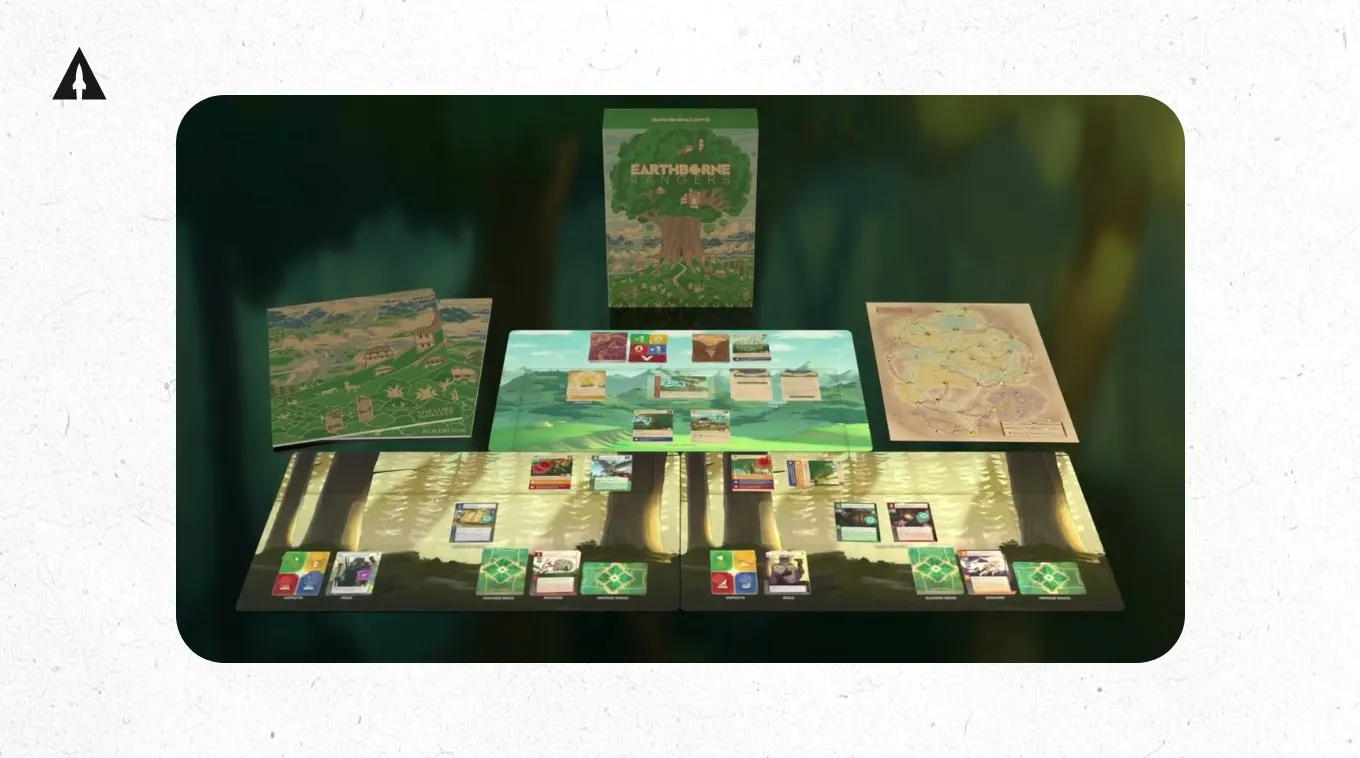
Earthborne Rangers emphasized eco-conscious materials and sustainable manufacturing, making choices that supported both brand values and long-term logistics. They worked with their manufacturer to source recycled and sustainable components without compromising quality.
This approach required more upfront research and potentially higher costs, but it aligned with the game’s environmental theme and resonated with their target audience. Players who care about conservation appreciated that the game’s manufacturing reflected those values.
The lesson isn’t that every game needs eco-friendly components. It’s that your manufacturing choices should align with your brand and your audience’s expectations. Thoughtful decisions create coherence between your game’s theme and its physical presence.
Why LaunchBoom Recommends Working with Established Board Game Manufacturers
At LaunchBoom, we’ve helped hundreds of creators navigate manufacturing for their crowdfunding campaigns. We’ve seen what works and what doesn’t, and we’ve learned that your manufacturer choice impacts everything from backer satisfaction to your ability to fund future projects.
Established board game manufacturers understand crowdfunding timelines and backer expectations in ways that generic factories don’t. They know that missing your delivery date by three months damages your reputation. They understand that component quality affects reviews and word-of-mouth. They’ve seen enough campaigns to anticipate problems before they happen.
Working with experienced manufacturers leads to better campaigns and higher customer satisfaction. Your backers can tell the difference between a game that was thoughtfully manufactured and one that was produced as cheaply as possible. That difference shows up in reviews, in repeat customers, and in your ability to launch future campaigns successfully.
The right manufacturing partner becomes a long-term relationship, not just a transaction. They learn your standards, understand your audience, and help you improve with each project. That partnership is worth more than saving a dollar per unit on your first game.
Final Thoughts
Manufacturing is where your vision finally becomes real, but it’s also where small mistakes can turn into big costs. The creators who succeed at this stage are the ones who stay proactive: they ask questions, review proofs carefully, and treat their manufacturer like a long-term partner, not just a vendor.
Selecting the right board game manufacturers impacts every stage of your business, from backer trust to future expansions. A game that arrives on time with exceptional quality builds a foundation for your next campaign. A game that arrives late with quality issues makes it harder to fund anything else.
Take the time to understand the production process, budget realistically for all costs, and build relationships with manufacturers who understand your vision. Your game deserves to be manufactured as well as it was designed.
Ready to launch your board game with confidence? Contact LaunchBoom to learn how we help creators navigate manufacturing, fulfillment, and successful crowdfunding campaigns. Schedule a free discovery call to discuss your project.
Board Game Manufacturing: Frequently Asked Questions
How Much Does It Cost to Manufacture a Board Game?
When people ask how much does it cost to manufacture a board game, the answer depends on several variables: tooling costs, material choices, setup fees, and your total order quantity. For a typical indie board game, expect to pay between $6.50 and $12 per unit for orders of 1,000–5,000 copies. That range accounts for different complexity levels, from simple card games to elaborate productions with custom components.
Your total cost includes one-time tooling fees (which might be $500–$5,000+ depending on custom components), per-unit material and labor costs, and setup fees for specific processes. Divide your total costs by your order quantity to get your per-unit manufacturing cost.
A rough estimation trick: find a game similar to yours, check its MSRP, and divide by 5 or 6. That should roughly equal your per-unit cost for manufacturing and shipping. But remember, this is just an estimate — there’s significant variance based on materials, weight, and component complexity.
What’s the Minimum Order Quantity for Board Games?
The minimum order quantity for board games is typically 500–2,000 units, depending on the manufacturer and your game’s complexity. This MOQ exists because mass production machines require significant setup time and cost, regardless of how many units you’re producing.
It takes just as much effort to set up an offset printer for 500 units as it does for 50,000 units. Once the machines are running, production is fast and affordable, but that initial setup cost needs to be distributed across enough units to make economic sense.
Larger order quantities significantly reduce your per-unit cost. A game that costs $12 per unit at 1,000 copies might cost only $6.50 per unit at 5,000 copies. However, larger orders require more upfront capital and create storage challenges, so you need to balance cost savings against practical constraints.
How Do I Begin Choosing a Board Game Manufacturer?
When choosing a board game manufacturer, start with this checklist to identify the right fit:
Communication quality: Do they respond promptly? Do they answer questions clearly? Can you understand each other despite language or time zone differences?
Track record: Have they manufactured games similar to yours? Do they have experience with crowdfunded projects? Can they provide references from other creators?
Proofing practices: Will they provide both digital and physical proofs? How many rounds of revisions are included? What’s their policy on changes after approval?
Post-launch support: What happens if there’s a quality issue with delivered games? How do they handle warranty claims or component replacements?
Request samples of similar components before committing to a manufacturer. Ask other creators privately about their experiences. Join board game creator communities where people share manufacturing recommendations and warnings.
The right manufacturer communicates clearly, has relevant experience, stands behind their quality, and treats your project as important regardless of its size.
What Is the Typical Game Manufacturing Timeline?
The typical game manufacturing timeline from file submission to delivered games is 3–6 months minimum. This breaks down into several distinct phases:
Proofing (1–2 weeks): Review digital PDFs of all components, checking colors, text, and layouts.
Pre-production samples (2–3 weeks): Receive and approve physical samples using your actual materials.
Mass production (6–10 weeks): The full print run is manufactured across multiple production lines.
Freight and fulfillment (4–12 weeks): Games ship via ocean freight, clear customs, and reach your fulfillment center.
Always build in buffer time for inevitable delays. Lunar New Year shuts down Chinese manufacturing for 2–3 weeks. Port congestion can add weeks of waiting. Component shortages can delay entire production runs.
If you promise backers delivery in October, your games should leave the factory in July. Use project management tools to track every dependency and deadline across this complex timeline.
What Impacts Board Game Component Costs?
Board game component costs are driven by several key factors:
Material type: Punchboard is cheapest, followed by wood and standard plastics, then acrylics, then metal. Each material has different production processes and cost structures.
Quantity: Larger orders distribute tooling costs across more units, significantly reducing per-component costs.
Complexity: Custom shapes, multiple colors, detailed sculpts, and unique sizes all increase costs compared to standard components.
Finishes: Linen texture, UV spot gloss, foil stamping, and embossing add cost but can enhance perceived value.
Packaging: Custom inserts, embossed boxes, and magnetic closures increase costs but improve the unboxing experience.
Focus your budget on components that actually enhance gameplay or significantly improve the player experience. A beautifully designed game with thoughtful component choices will outperform an over-produced game with unnecessary upgrades that inflate your price point without adding real value.
