



Getting your product idea stolen is every inventor’s nightmare. But here’s the thing – most solo inventors and small businesses think patenting is completely out of reach. That’s just not true.
I’m going to show you exactly how to patent a product in 7 straightforward steps. No legal jargon. No overwhelming complexity. Just a practical, easy-to-follow roadmap that protects your intellectual property and gives you a real competitive edge in the market.
Over the past 10 years, my company LaunchBoom has helped product creators launch over 1,000 products. Whether they’re launching on Indiegogo vs Kickstarter, I’ve learned the patent process through working with inventors who’ve successfully navigated this system – including Joseph Wu, who has over 500 products and 3 patents under his brands Master Tailgaters and Fuse Audio.
I interviewed Joseph to get his expert insight into the patent process. The result is this in-depth guide.
Also, if you’d rather watch instead of read, I made this YouTube video going over the same stuff in the blog post!
Key Takeaways
- Most ideas don’t qualify for patent protection – your invention must meet three specific criteria: novelty, usefulness, and non-obviousness
- Patent searches are essential – skip this step and you’ll waste thousands of dollars on an application that can’t be approved
- Two main patent types exist – utility patents protect how your invention works, design patents protect how it looks
- Professional help saves money long-term – patent attorneys cost $8,000-$30,000 but can prevent costly mistakes
- Office Actions are normal – expect 2+ rounds of examiner feedback during the 12-36 month approval process
- Filing fees vary by entity size – micro entities pay as little as $60-$70 for basic applications
What Does It Mean to Patent a Product?
A patent is essentially a legal monopoly. It gives you exclusive rights to make, use, and sell your invention for a specific period of time – preventing anyone else from copying your idea without permission.
But here’s what most people don’t understand: patents don’t protect ideas. They protect specific inventions that solve problems in new and innovative ways.
There are two main types of patents you need to know about:
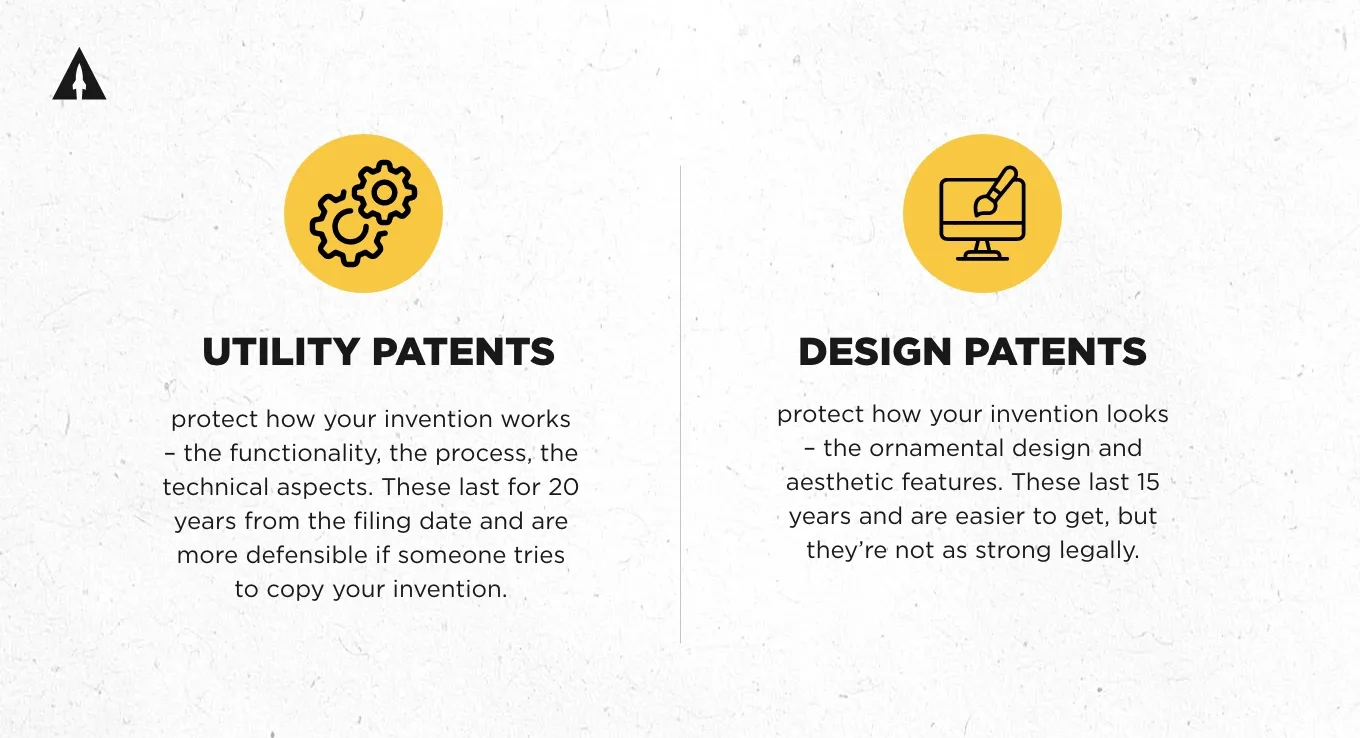
- Utility patents protect how your invention works – the functionality, the process, the technical aspects. These last for 20 years from the filing date and are more defensible if someone tries to copy your invention.
- Design patents protect how your invention looks – the ornamental design and aesthetic features. These last 15 years and are easier to get, but they’re not as strong legally.
Think about Apple’s iPhone. They have both utility patents (for how the touchscreen technology works) and design patents (for the phone’s distinctive appearance). This gives them maximum protection.
How to Patent a Product in 7 Steps
Getting a patent isn’t as mysterious as it seems. There’s a clear process that thousands of inventors follow every year.
The key is understanding each step before you start spending money. Because once you begin the patent application process, making changes gets expensive fast. Here’s your complete roadmap:
1. Determine If Your Product Is Patentable
Before you do anything else, you need to figure out if your idea can actually be patented because most ideas don’t qualify for patent protection. For your invention to be patentable, it needs to meet three key criteria:
- It has to be novel. This means your invention has to be new. It can’t have been publicly disclosed, sold, or patented before.
- It has to be useful. Your invention has to have a practical purpose or benefit. It can’t just be theoretical or purely decorative. A new kitchen gadget that helps people cook faster would be considered useful, while a statue of a kitchen gadget would not.
- It has to be non-obvious. This is where it gets subjective. Your invention can’t be something that would be obvious to someone skilled in your field. It has to involve some level of creativity or innovation.
For example, if you invented a coffee mug with technology that prevented coffee from staining teeth, that could be non-obvious. But if you just made a coffee mug with a superhero graphic printed on the mug, that would probably be considered obvious. Take time to honestly evaluate your invention against these three criteria before moving forward.
2. Conduct a Patent Search Using Trusted Methods
Before you spend time and money on a patent application, you need to see if someone already has a patent similar to your idea. Here’s what Joseph Wu recommends: “Before reaching out to a patent attorney, go to the USPTO website and start typing in some key words about your product and see what’s out there.” The most effective patent search methods include:
- USPTO website – the official database of all U.S. patents
- Google Patents – more user-friendly interface for searching
- AI tools like ChatGPT – can search Google Patents for you using natural language
Patent language can be confusing. If you’re unsure about what you find, hire a patent attorney to do a comprehensive search and analysis. This typically costs $1,000 to $3,000. But that’s way cheaper than filing a patent application only to discover later that your idea isn’t patentable.
3. Decide Which Type of Patent to Pursue
Once you’ve confirmed your idea is patentable, you need to decide which type of patent to get. As I said above, there are two types of patents: utility and design patents. Choose which one you believe you will be qualified for. Here’s a breakdown again of the differences between the two:
| Patent Type | What it protects | How long it lasts | Defensibility |
|---|---|---|---|
| Utility | How your invention works | 20 years | More defensible |
| Design | How your invention looks | 15 years | Less defensible |
4. Prepare Your Patent Application Thoroughly
Now we’re getting into the heavy lifting. You have two main routes: start with a Provisional Patent Application and then file a Non-Provisional Patent Application later, or go straight to a Non-Provisional Patent Application.
Provisional Patent Applications are like placeholders. They’re not examined by anyone at the patent office, but they hold your spot in line for one year. Before that year ends, you must file a Non-Provisional Patent Application to keep your patent alive. When you see products that are “patent pending,” they’ve filed a patent application, often a provisional.
Non-Provisional Patent Applications are the real deal. They’re more expensive and require detailed technical drawings and descriptions, but they actually get examined and can become granted patents.
Starting with a provisional application can be smart if you’re still developing your product or need time to secure funding. It’s cheaper upfront and gives you a year to refine your invention.
But preparing these applications is incredibly difficult to do well. The language has to be precise, the technical descriptions have to be comprehensive, and one single mistake can sink your entire application. The complexity of the patent application process is why most successful inventors work with patent attorneys.
5. Learn How to Write a Patent Claim Properly
Patent claims are the most critical part of your application. A patent claim defines exactly what your patent protects. It’s the legal boundary that determines whether someone is infringing on your patent or not.
And writing a patent claim requires extremely precise legal language – it can be highly technical and legalistic. One poorly written claim can make your entire patent worthless.
While it’s possible to write your own patent claims, I’d strongly recommend consulting a professional for this step. The legal significance is too important to risk getting wrong.
Patent attorneys understand the specific language patterns and legal requirements that make claims enforceable. They know how to write claims that are broad enough to provide real protection but specific enough to get approved.
6. File Your Application With the USPTO
Once your application is prepared, it’s time to submit it to the USPTO. The good news is this part is straightforward. Patents can be filed online through the USPTO’s web portal or by mail. Filing fees depend on what type of entity you are and which type of application you’re submitting:
| Basic filing fee | Micro Entity | Small Entity | Large Entity |
|---|---|---|---|
| Provisional Patent | $65 | $130 | $325 |
| Non-Provisional Utility Patent | $70 | $140 | $350 |
| Design Patent | $60 | $120 | $300 |
A non-provisional application also owes search and examination fees when you file. With those, a utility filing runs $2,000 (large), $800 (small) or $400 (micro), and a design filing $1,300, $520 or $260. A provisional has no search or examination fee. See the USPTO fee schedule.
Most individual inventors and small businesses qualify as micro or small entities, which reduces costs. If you hire a patent attorney, they’ll handle this entire step for you. They know exactly how to navigate the USPTO system and make sure everything is filed correctly and on time. But if you’re doing it yourself, double-check everything before hitting submit. Once it’s filed, making changes gets complicated and expensive.
7. Wait Through the Patent Approval Timeline
Now comes the waiting game. Once your application is submitted, a USPTO examiner will review it to make sure it meets all requirements for patentability. This process typically takes 12 to 36 months.
Yeah, that’s a long time. But with nearly 800,000 applications waiting for a first review (April 2026), it makes sense.
Most applications (about 85–90%) are rejected at least once first, in what’s called an Office Action. This isn’t a final rejection – it’s the examiner saying “we have some concerns about your application” and listing specific issues that need to be addressed.
Don’t panic if this happens. It’s totally normal.
Here’s what Joseph Wu says about the patent approval timeline: “Expect at least 2 office actions… you’ll follow the first time… cross your fingers you’ll be done but many times the examiner will find something else… so typically my attorney says on average they’ll have 2.”
This is where having a good patent attorney becomes really valuable. They know exactly how to respond to these actions and address the examiner’s concerns.
Real-World Lessons From a Multi-Patent Entrepreneur
Joseph Wu has been through this process multiple times. He’s got 3 patents and 500+ products on the market under his brands Master Tailgaters and Fuse Audio. Here’s his real-world advice:
- The value of patent attorney consultation is huge. Joseph recommends finding “a reputable patent attorney that maybe someone you know has worked with.” While it’s expensive upfront – patents cost anywhere between $8,000 to $30,000 – it saves time and money by doing it right the first time.
- Expect multiple Office Actions. As Joseph mentioned, most applications go through at least 2 rounds of examiner feedback. This is normal, not a sign that your application is weak.
- Invest in a strong application from the start. You don’t want your application rejected, but you also don’t want a weak patent granted that doesn’t actually protect your invention.
Joseph’s experience shows that working with professionals and being patient through the process leads to better outcomes.
Should You Work With a Patent Attorney?
Here are the main benefits of patent attorney consultation:
- Deeper legal knowledge – they understand patent law intricacies that can make or break your application
- Better claim writing – they know how to write enforceable claims that provide real protection
- Reduced chance of rejection – their experience helps avoid common mistakes that lead to Office Actions
As Joseph said before, working with a patent attorney typically costs $8,000-$30,000. Yes, that’s a significant investment. Especially if you also factor in how much a Kickstarter campaign costs to launch your product.
But consider this: small errors in patent language can jeopardize your protection entirely. A lawyer isn’t legally required, but they’re highly recommended for anything beyond the simplest inventions.
Patent attorneys make sense when you have a complex invention, when your product has significant commercial potential, or when you’re in a competitive industry where patent protection is crucial.
Final Thoughts
Protecting your product ideas doesn’t have to be overwhelming. The patent system exists to encourage innovation by giving inventors temporary monopolies on their creations. But you have to take control of your intellectual property from the beginning.
Use this step-by-step approach: evaluate patentability, conduct thorough searches, choose the right patent type, prepare detailed applications, write strong claims, file correctly, and be patient through the approval process.
Don’t let the complexity scare you away from protecting what you’ve created. Reach out for professional help when you need it, but don’t let that stop you from getting started. Your ideas deserve protection. Now you know how to patent a product and make that protection a reality.
Ready to take the next step? Talk to one of our crowdfunding experts about launching your product. Just let us know some info on what you’re launching and we’ll set up a comprehensive launch plan.
How to Patent a Product: Frequently Asked Questions
What Is the First Step to Patent a Product?
The first step is to assess patentability by checking if your invention meets three criteria: novelty, usefulness, and non-obviousness. Don’t invest time or money in the patent process until you’ve honestly evaluated whether your invention qualifies for protection. Most ideas don’t meet these requirements, so early-stage evaluation saves you from wasting resources on applications that can’t be approved.
How Long Does It Take To Get a Patent Approved?
The patent approval timeline typically ranges from 12 to 36 months after filing your application. This extended timeframe reflects the USPTO’s thorough examination process and current backlog of nearly 800,000 applications. The exact timing depends on your patent type, the complexity of your invention, and the examiner’s workload. Remember that Office Actions are part of this timeline – most applications go through multiple rounds of examiner feedback before approval.
Where Can I Search for Existing Patents?
The most effective patent search methods include the USPTO database, Google Patents, and AI tools like ChatGPT. Start with the USPTO website for official records, then use Google Patents for a more user-friendly search experience. ChatGPT can help by searching Google Patents using natural language queries about your product. Be cautious when reading patent language – it’s highly technical and legal. If you’re unsure about your search results, consider hiring a patent attorney for a comprehensive analysis.
How Much Does It Cost to Patent a Product?
Basic USPTO filing fees range from $60-$350 depending on your entity size and patent type. Micro entities pay the lowest fees: $65 for provisional patents, $70 for utility patents, and $60 for design patents. Small entities pay double these amounts, while large entities pay about 5 times more. However, total costs including attorney fees typically range from $8,000-$30,000. While expensive upfront, professional help often saves money by avoiding rejections and ensuring strong protection.
Can I Write My Own Patent Claim?
You can write your own patent claim, but the process requires understanding how to write a patent claim using precise legal language. Patent claims define exactly what your patent protects and determine whether someone infringes on your rights. The claim section is highly technical and legalistic – one poorly written claim can make your entire patent worthless. While it’s technically possible to write claims yourself, I’d recommend consulting a professional for this critical step to avoid future complications.
Do I Need a Lawyer to File a Patent?
A lawyer isn’t legally required to file a patent, but they’re highly recommended for most situations. DIY filing may be feasible for simple inventions with limited commercial potential. But legal help becomes crucial for complex inventions, products with significant market potential, or competitive industries where strong patent protection matters. Remember that small errors in patent language can jeopardize your protection entirely. The upfront cost of professional help often prevents much larger losses later.
