


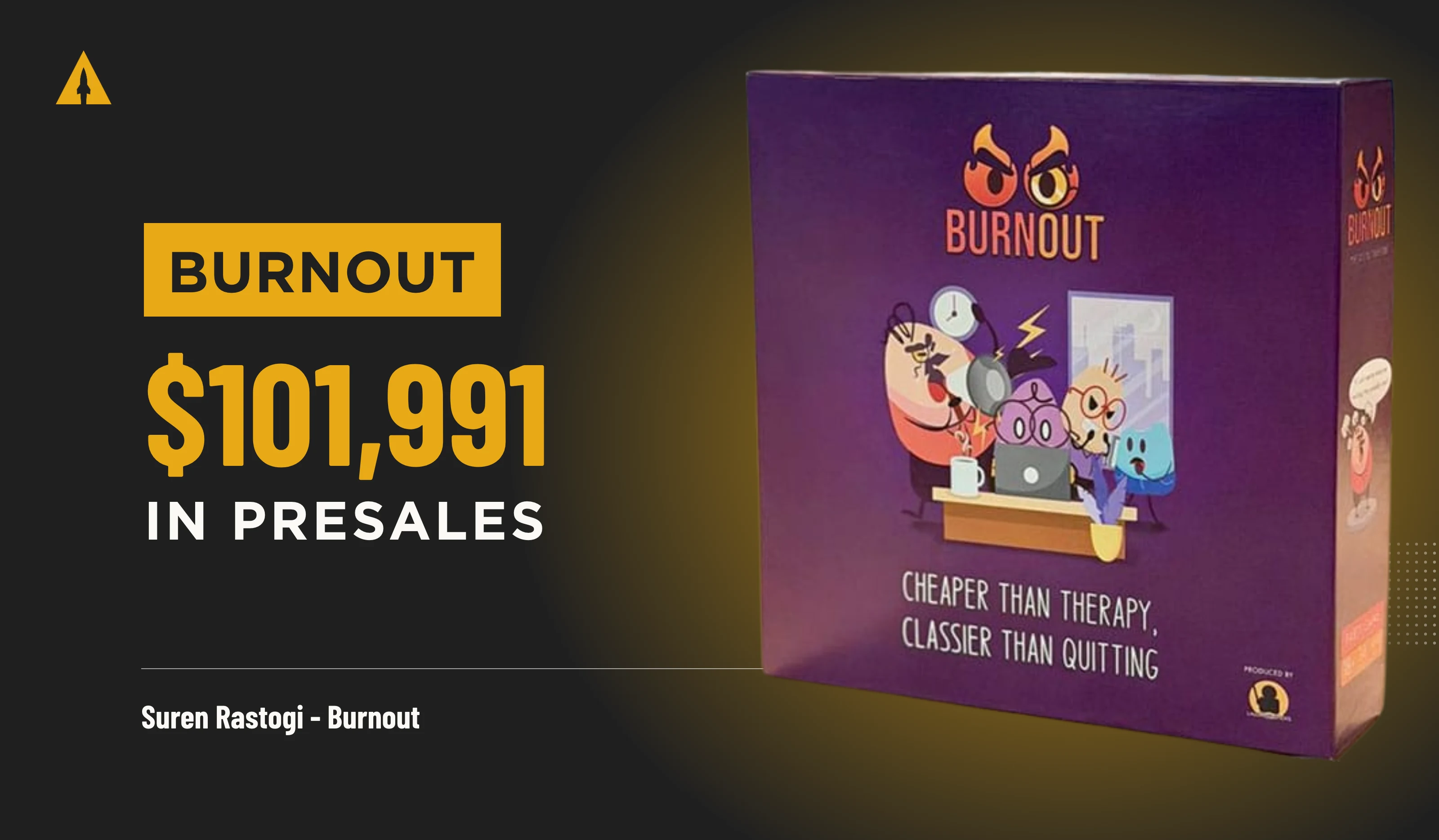
Suren Rastogi wanted to launch in October. Victor Shiu, our Director of Games, told them to wait.
That one piece of advice shaped everything after it. Suren and his teammate Janice used the extra six months to grow their $1 VIP list, learn from their ads and build a community in person. Then the Burnout Board Game Kickstarter went live and raised $101,991 from 1,688 backers.
Here’s how a marketer who hadn’t played board games in years got there, and why Suren calls waiting the best advice they could have gotten.
If you’d rather listen, here’s my chat with Suren on our podcast, Masters of Crowdfunding:
Key Takeaways
- Wait until the numbers say go: Pushing the launch back six months gave Burnout time to grow its $1 VIP list and set up the strong first day Suren calls the key to a good Kickstarter.
- Find the gap before you build: Lots of games are about office life, but none of them touched mental health, and that gap became the whole idea.
- Build the shareable moment into the game: At the very first playtest, players photographed the handwritten cards and posted them on Instagram.
- Plain ads can beat polished ones: A simple picture of the box in an office did really well, and the team never saw it coming.
- Small rooms add up: Meetups with ten people, game nights in people’s homes and sessions at companies all ended with a QR code to their website.
Who Suren Rastogi Is and Where Burnout Came From
Suren works in marketing. As AI took off, Suren watched it take over a lot of the work he loves doing: writing copy, making art, coming up with ideas. So the question kept coming back. Go deep into AI, or find another way to protect a career?
Here’s where Suren landed:
“And my insight that I had one morning was that a physical product is one way to protect yourself.”
Suren didn’t know what that product would be yet. Then he woke up one day and thought: board game. Which is a little funny, because Suren hadn’t played board games in years.
So Suren got in touch with Janice, a former intern who plays a lot of games. Over the next few months they played everything they could, and Suren fell in love with the hobby and with making a game of his own.
Their first idea didn’t last. It was a political satire called East Coast Plan, built around something that happened in Singapore’s elections, and it only made sense if you knew Singapore’s politics. They found out they just weren’t that interested in politics. Suren explained why that killed it:
“So to even conceptualize what happens in the game was very difficult for us to do without learning a lot more about politics and really making the game feel real.”
Finding a Gap Nobody Had Filled
The next idea came from lunch, dinner and coffee. Everyone they talked with complained about their boss, their coworkers or their company. So Suren and Janice asked themselves why they didn’t make a game about that.
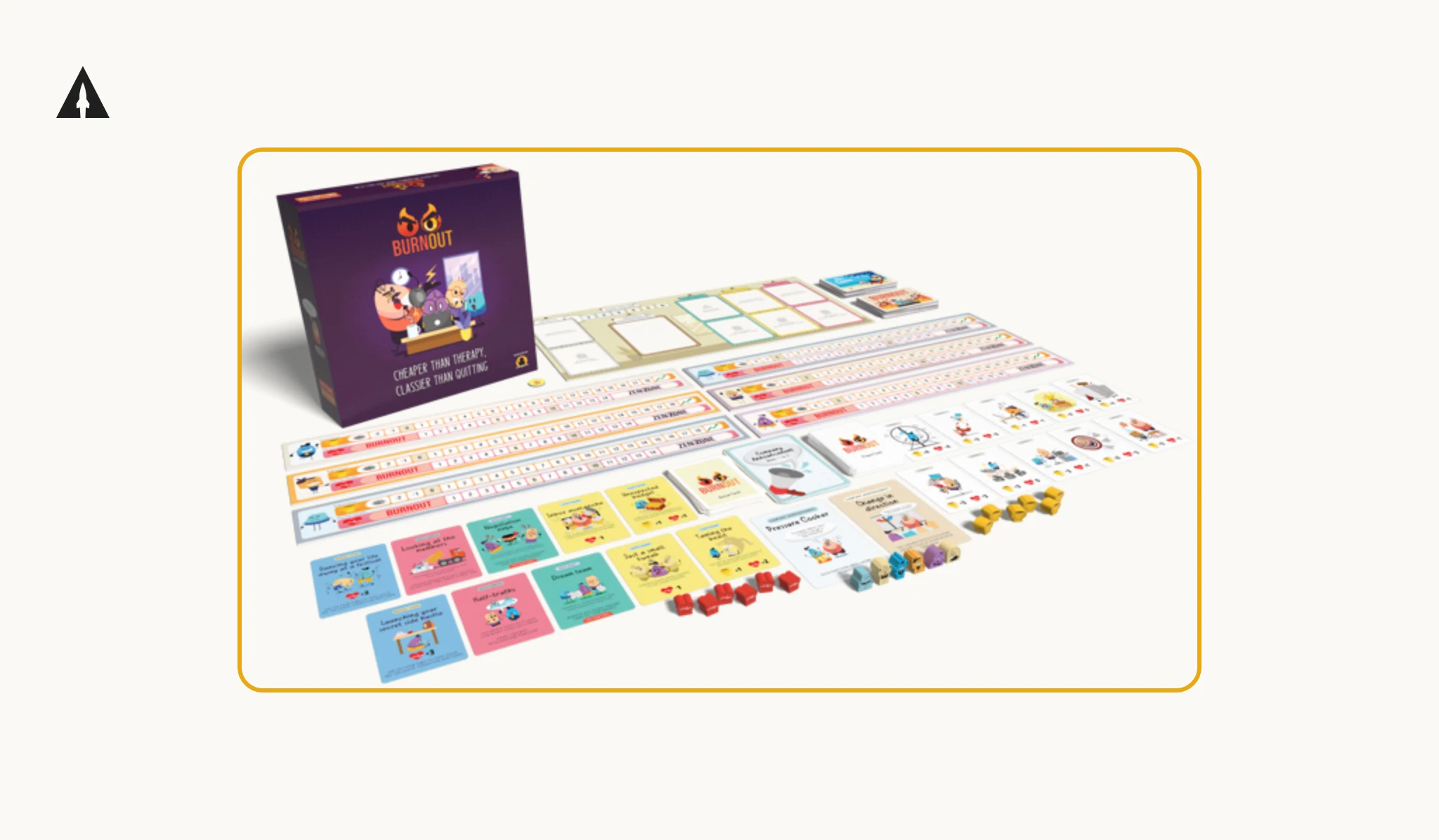
Today Suren describes Burnout as a board game made to normalize conversations about mental health at work.
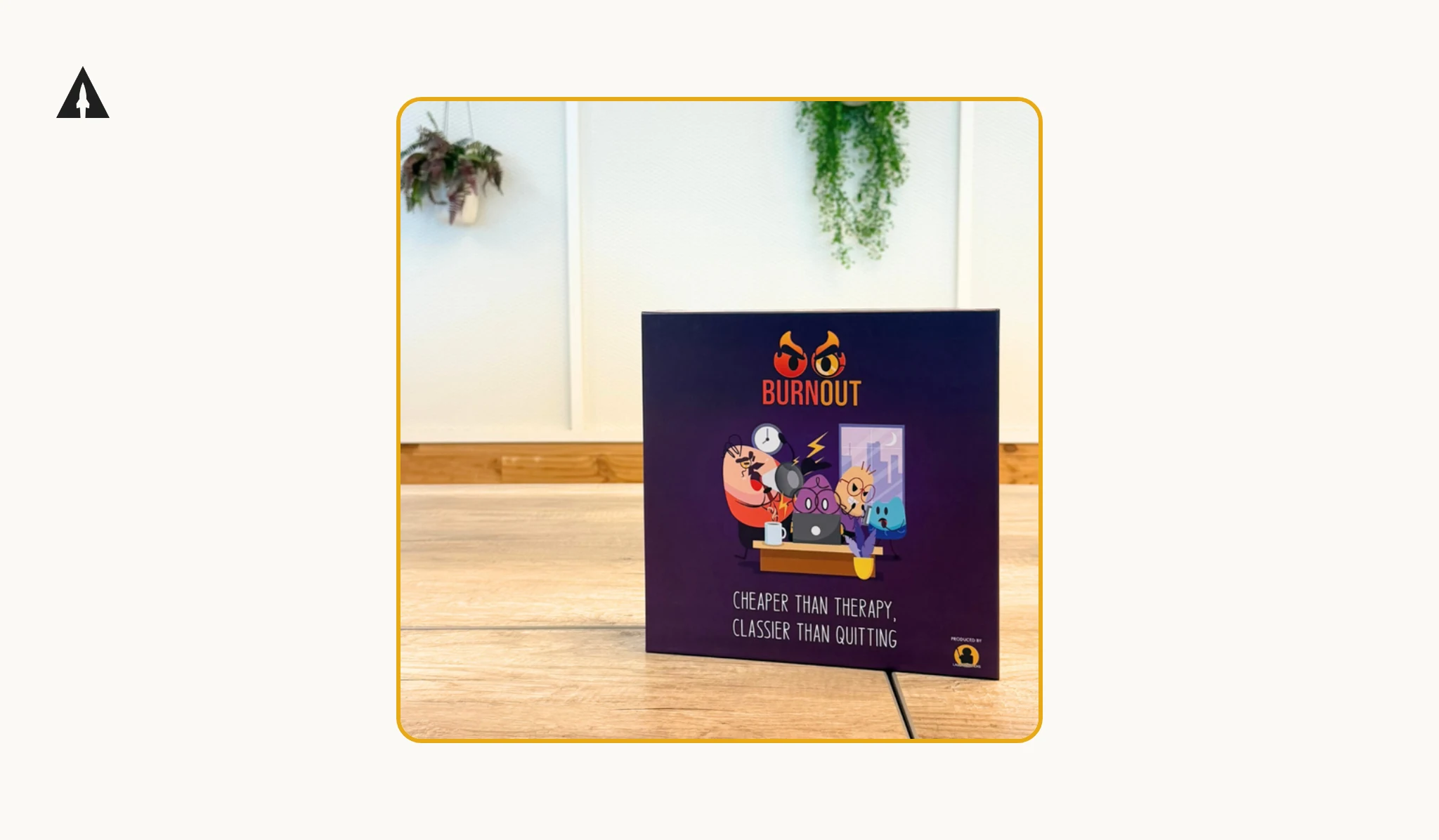
Before they committed, they made two or three versions of the idea and looked at what was already out there. They found plenty of games about work and corporate life. None of them touched mental health.
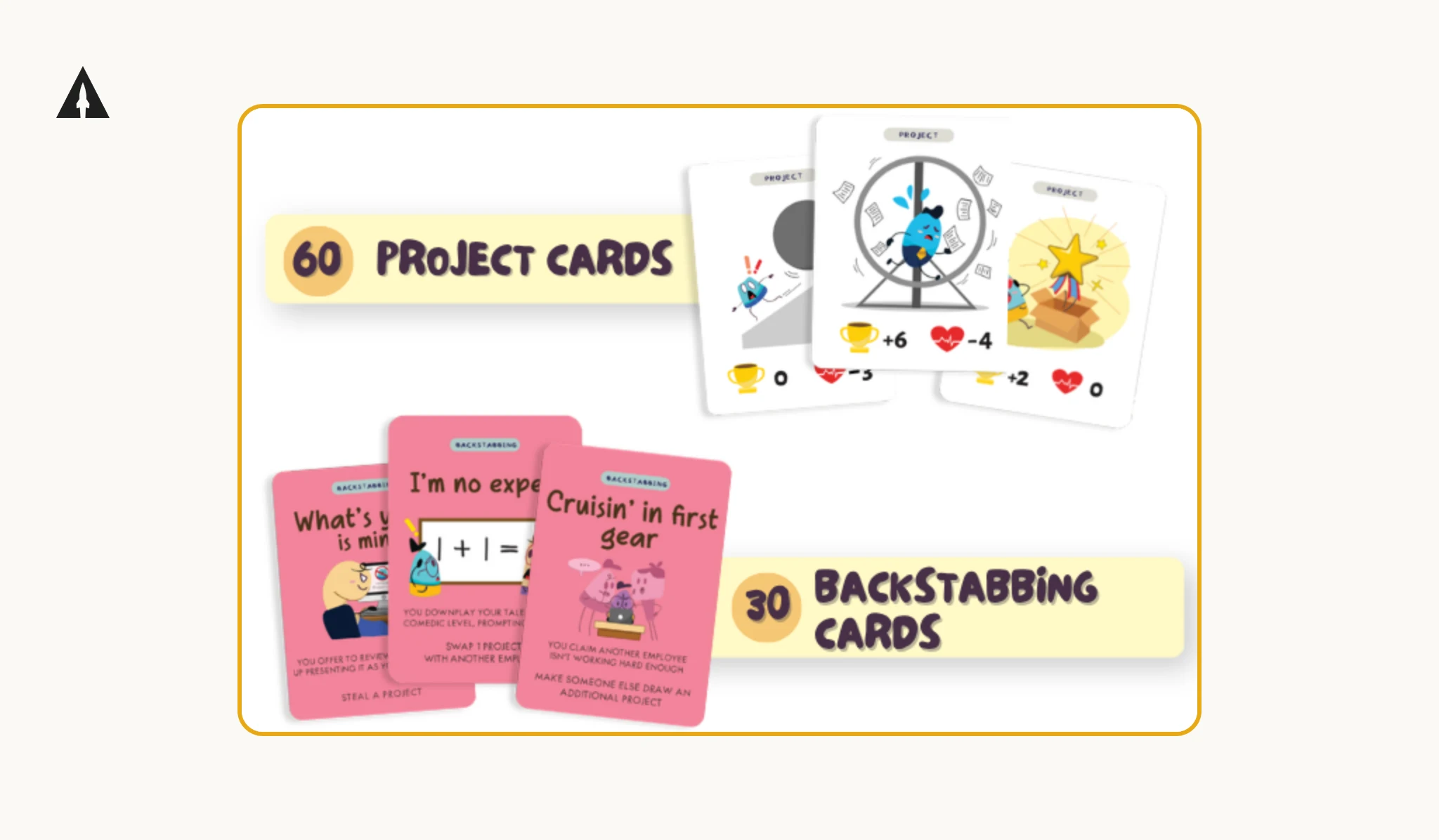
In Burnout, you’re trying to get a promotion by building the highest reputation. But you’re also trying not to burn out, so every player watches two scores at once.
Suren thinks that research step matters a lot. Since the Kickstarter, they’ve had other game ideas, and one of them turned out to be nearly exactly what was already out there. “You don’t want to put something out that’s very similar to something that’s already out there,” Suren told me.
There’s a flip side too. If nobody has made a game about a topic, it might be because nobody cares about that topic. So finding a gap isn’t enough. You still have to test whether people actually want it.
The First Playtest: Handwritten Cards
That test came at their first public playtest. The board was drawn in pencil on printer paper, and the cards were text only. Here’s what Suren saw:
“We actually had cards which were only text based. We wrote them by hand and people were taking photos of those cards, sharing it online on Instagram.”
They didn’t even have an Instagram page yet. People were laughing, and when the first round ended, they played a second one. The same thing happened over the next three or four playtests. That was enough to convince Suren and Janice to go deeper.
The cards worked because the scenarios were real. They made the game satirical on purpose, because real work problems with no humor around them just feel like more work. And they kept the scenarios close to what actually happens at a job. Suren’s favorite card is the one where you’re doing good work, so your boss gives you more work.
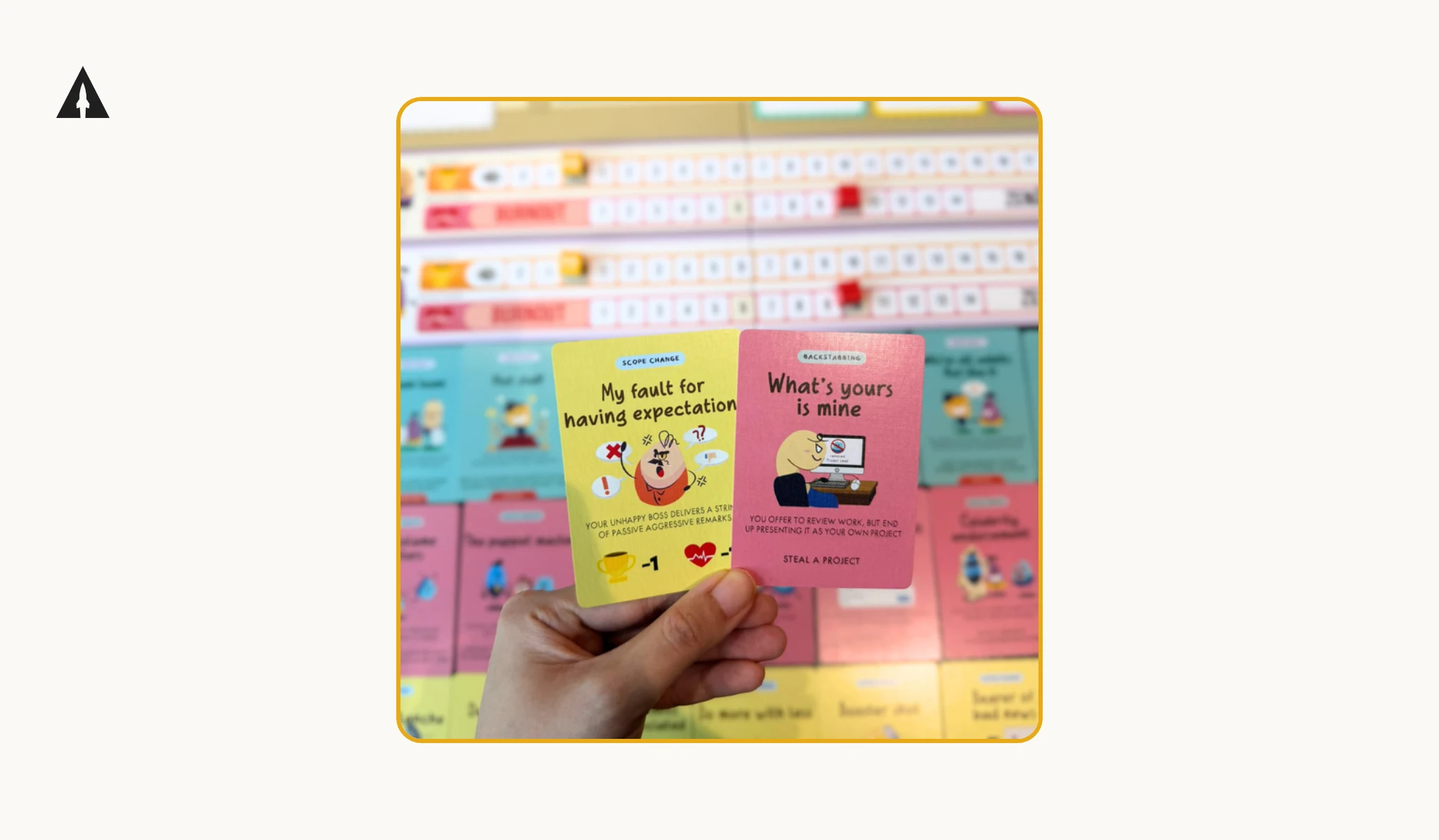
Those are the moments people relate to. They’re also the ones people snap pictures of and share. For a founder, that’s marketing built right into the box.
Running It Like a Business From Day One
From the start, Suren and Janice treated Burnout as a business, not a hobby. Suren put it this way:
“And I think once you think about [Kickstarter] as a business, the way you operate it changes a lot.”
That meant setting aside a real investment up front, enough to give them runway and a long-term plan. It also meant working to look trustworthy as a first-time founder.
Backers worry about first-time founders. Will this person take my money and disappear? Suren’s answer was proof. They built real prototypes, showed live reactions from people playing the game, and paid to go to Spiel Essen so people could meet them and see they were a legitimate company.
At first, Suren worked on Burnout on weekends. Once the playtests kept going well, it was clear the game needed him full time.
The Problem: A Launch Date Set Too Early
Suren and Janice partnered with my team at LaunchBoom, and they worked most closely with Victor. Their plan was to launch in October, at the same time as Spiel.
Victor said no. Suren remembers the conversation like this:
“We were planning to launch in October last year along with Spiel and [Victor] said, No, don’t do it. Because you are just starting out your one dollar VIPs. You don’t have a full email list yet.”
Now, I understand that pushing back a launch hurts. You’ve picked a date, you’ve told people, and maybe you’ve planned around a big convention. Still, the numbers didn’t support October.
Looking back, Suren sees what launching early would have cost them. They wouldn’t have hit the order thresholds they were aiming for in each market. They wouldn’t have learned as much from their ads. The last one mattered most to Suren:
“And most importantly not had a good first day, which is the key to getting a good Kickstarter.”
This comes up with founders all the time. A lot of our clients have a launch date they really want to hit, even when the numbers say the launch probably won’t go well. I’d always rather you let the data tell you when to launch.
What Changed with LaunchBoom: Six More Months of Pre-Launch
Victor gave them a way to project how the campaign would do, so the launch date could come from data instead of a calendar. Suren and Janice later built that into a more detailed sheet, pulling in information from Reddit and BoardGameGeek. Now they share it with local designers who are getting ready to launch on Kickstarter.
Then they put the extra six months to work. Even coming from marketing, a lot of pre-launch was new to them. In Suren’s words:
“And there’s a lot of things that we thought we knew which we did not know, which is the whole part about the pre-launch, building your one dollar VIPs.”
During pre-launch, people pay $1 to reserve their spot before launch day. That list is what Victor was watching, and in October it was just getting started.
Over the full pre-launch, Burnout’s ads spent $10,705.14, and the list grew to 4,282 leads and 978 reservations. (The ad account ran in Singapore dollars, so every ad figure in this post was converted to US dollars.)
Waiting six months took Burnout from 39 reservations to 978
Running total of $1 reservations at the end of each week, October 20, 2025 to April 20, 2026
See the numbers
| Reservations | |
|---|---|
| Oct 20 | 39 |
| Oct 27 | 85 |
| Nov 3 | 120 |
| Nov 10 | 146 |
| Nov 17 | 172 |
| Nov 24 | 194 |
| Dec 1 | 228 |
| Dec 8 | 250 |
| Dec 15 | 268 |
| Dec 22 | 268 |
| Dec 29 | 270 |
| Jan 5 | 270 |
| Jan 12 | 270 |
| Jan 19 | 300 |
| Jan 26 | 359 |
| Feb 2 | 418 |
| Feb 9 | 480 |
| Feb 16 | 578 |
| Feb 23 | 646 |
| Mar 2 | 713 |
| Mar 9 | 793 |
| Mar 16 | 866 |
| Mar 23 | 935 |
| Mar 30 | 962 |
| Apr 6 | 963 |
| Apr 13 | 965 |
| Apr 20 | 978 |
Ads Built for Each Market
The ads didn’t go everywhere. They focused on Singapore as the home market, plus the US, the UK, the EU, and Australia and New Zealand.
The reason was a business one. Fulfillment companies told Suren that hitting a certain number of orders in each of the four markets outside Singapore would lead to a distributor deal or cheaper shipping. So the ads were aimed at hitting those numbers, market by market.
They also found that one video didn’t work everywhere. The performance in other markets wasn’t as good, so they made a version for each one. In the US, an American friend was the face of the ad for the opening, and the rest of the video stayed the same. In the UK, they paid a content creator whose work they liked to make an ad, and it did pretty well. She was the only creator they paid.
The box in an office
Burnout’s cards always did decently in ads. The surprise was something much simpler. Suren described it this way:
“But surprisingly it was just the picture of our box in an office environment that [did] really, really well and it was something that we really didn’t think of.”
Suren and his wife both come from marketing, mostly at banks, where ads look very polished. This one wasn’t, and it worked anyway. “But sometimes the more raw, natural ideas work better,” Suren said.
The pre-launch ad with the most spend was an office scene. All 39 copies of it together spent $3,475 and brought in 1,437 leads and 265 reservations.
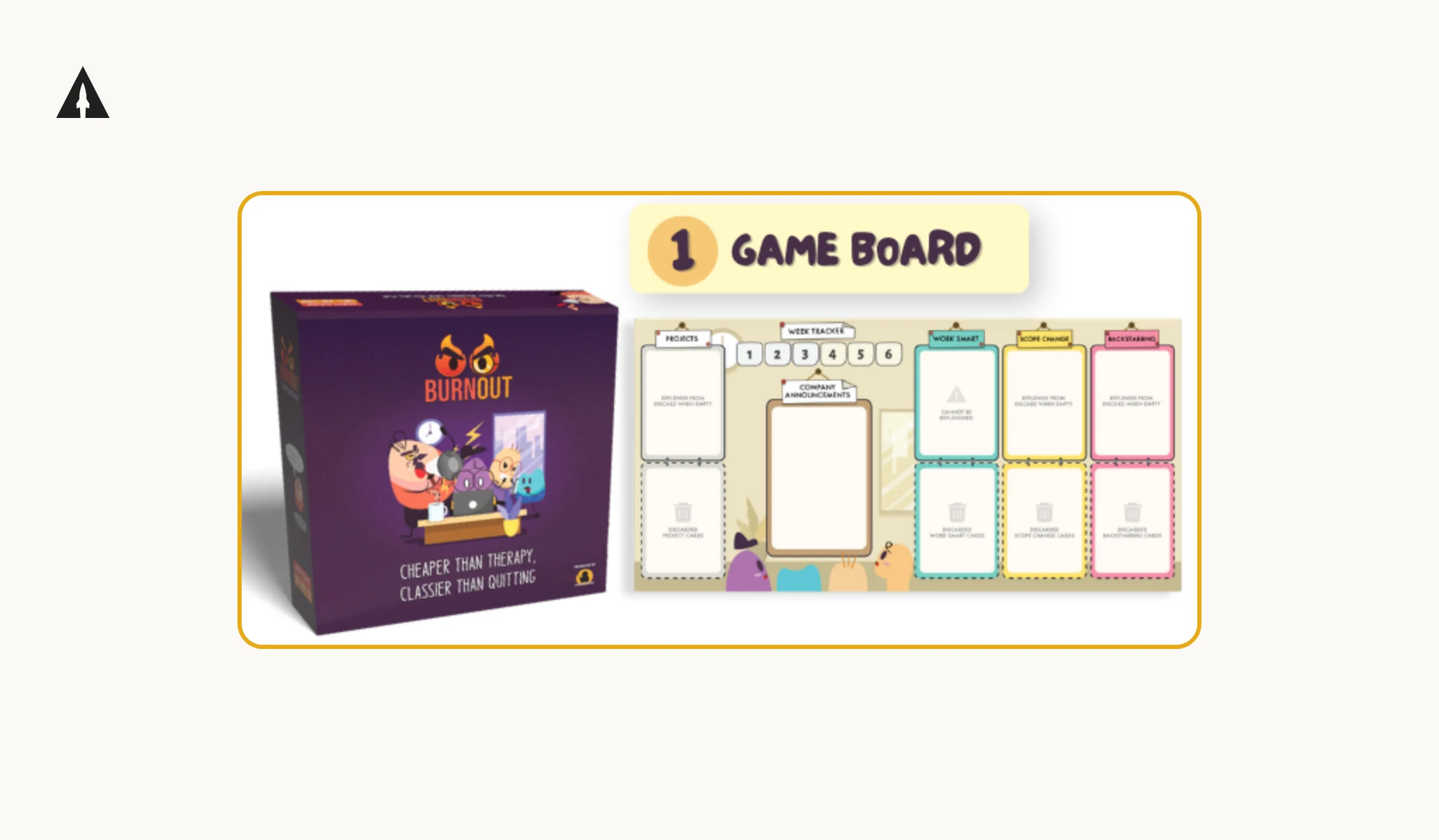
As I told Suren on the episode, the box art is usually one of the best ads. Founders try so many creative ideas, and you should test them. But a lot of the time the winner is just the box, shown in the place the game’s theme happens or on a plain background. It shows why the art matters so much in games.
Building the Community Offline
Ads were half the plan. The other half happened in person.
Suren and Janice went to every local event they could in Singapore, even ones they expected to draw ten people. They’d play other games with the people there first, then mention they had a game of their own. People were always willing to try it.
Honestly, it didn’t always feel worth it. Suren remembers asking, “Why am I going for an event just for 10 people?”
Over time, it added up. At board game meetups, there was often a line to play Burnout, and some people had to leave before their turn. So Suren and Janice took their details and offered to come to their homes and run a game for their friends. On trips to Malaysia, Dubai and the US, they brought the game and met up at a cafe with people who had reached out to them.
Some players went further and asked them to run a session at their company. A session like that puts the game in front of a whole department of people who have never played it.
Every session ended the same way. Players scanned a QR code to the website, or at the very least followed Burnout on Instagram. At events with one table, Suren ran a game, then stepped away to talk with that group while Janice ran the next one. That way every group got a real conversation with one of them.
Launch Day
Launch day was a party. Friends came over, there was pizza, and everyone counted down together. Going in, they had a clear expectation:
“So we expected our campaign to end anywhere from fifty thousand to sixty thousand US dollars.”
Based on that, they figured they’d hit their goal within an hour. They hit it within minutes.
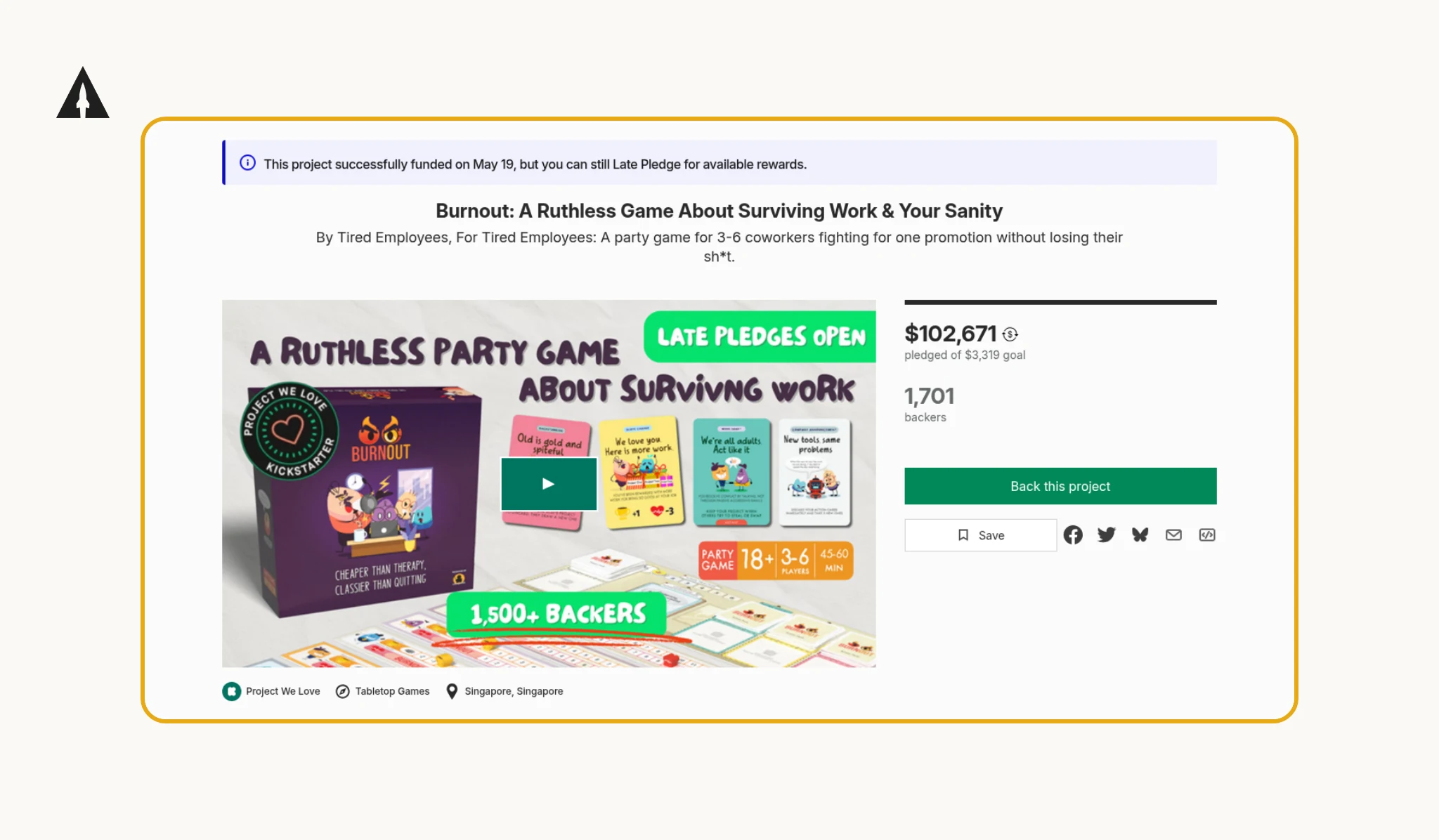
Everyone sat in front of the big screen TV, clapping every time the number went up. Suren called it an exhilarating moment: “I would do another [Kickstarter] just to feel that high of the start of a campaign.”
The Results
The Burnout Board Game Kickstarter ran from April 21 to May 19, 2026. It raised $101,991 from 1,688 backers, well past what Suren and Janice expected going in.
During the launch, Burnout’s ads spent $3,808.84 and brought in 204 purchases.
Here’s what the launch gave them:
- $101,991 raised on Kickstarter
- 1,688 backers
- 978 reservations before launch day
- A community built in person, in Singapore and on trips abroad
- A projection sheet they now share with local designers
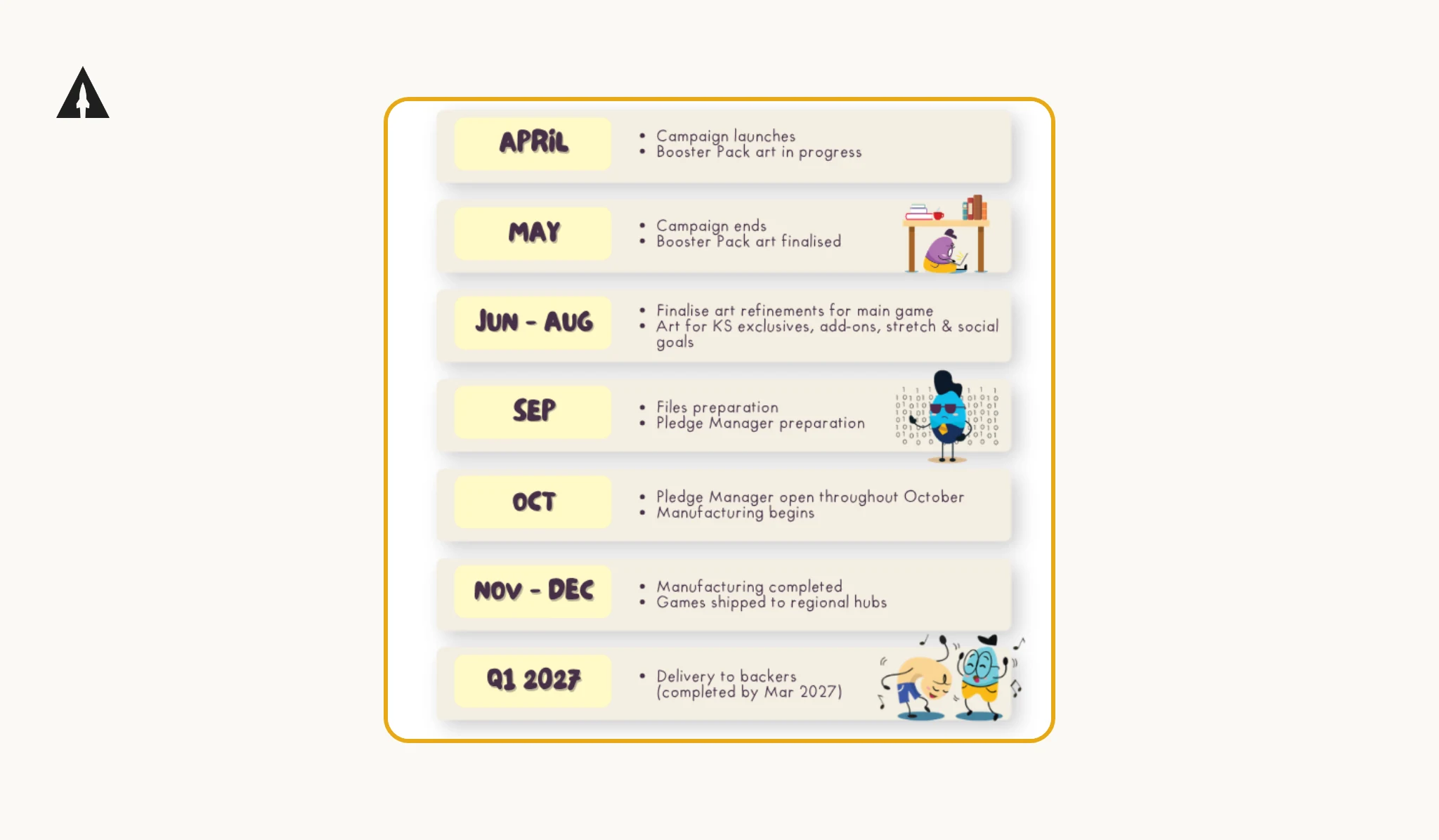
The business didn’t stop at the campaign. Suren told me they’re profitable now, with business-to-business work and merchandise on top of the game. Next up are another game called Triggered, a sequel to Burnout, and an e-commerce plan they’re working on with my team again. When we recorded, manufacturing was about to start.
Suren’s Advice for Founders
Don’t launch just to hit a date
This is the big one. If your VIP list and email list aren’t ready, push the launch back. Use the time to build your community and make your ads better. Suren and Janice did exactly that, and they got the strong first day they wanted.
Do your market research
Check what’s already out there before you build. Make sure your idea isn’t already a game, and test whether people actually want a topic nobody has covered yet.
Make the game itself shareable
Burnout’s real, funny work scenarios were the thing people photographed and posted. If your game has moments like that, people will do some of your marketing for you.
Show up, even for small rooms
An event with ten people can feel like a waste of time. Do it anyway, and make sure every session ends with a QR code to your page or an Instagram follow.
The Takeaway
Suren Rastogi started with a worry about AI and no board game background. He ended up with a Kickstarter that raised $101,991 from 1,688 backers.
The biggest turning point was a launch that didn’t happen. Instead of launching in October, Suren and Janice waited, grew their $1 VIP list, learned which ads worked in which markets and showed up at every event they could find. When they finally launched, they hit their goal within minutes.
If you’re a founder with a game and a launch date in mind, book a call with a growth strategist on my team and we’ll talk through your project, including whether your numbers say it’s time to launch.
